TEARS in a Bottle by Virginia Hughes

In the early 70's, Jim Croce released his hit, "Time in a bottle," you may remember the nostalgic, wistful words about there not being enough time to spend together, but how important to know the one you want to go through time with. Look it up and you'll find the song remains relevant. This longing for more time with a loved one becomes more realized as one ages. 

You may have seen a ship in a bottle, and know the intriguing magic to make that happen. Maybe you've put a message into a bottle, and thrown it hopefully into the tide never knowing if it will reach someone on the other side as it's carried out to sea. 

But have you ever thought about tears in a bottle?  David mentions this idea in Psalm 56. He is caught by enemies and afraid. As he talks to God he is crying. He notes that these aren't the first tears he has shed and reminds God of this fact. 

Remember, David is a mighty warrior. With God's help, he has taken down wild beasts like lions. He has slain a real giant. It is compelling how David, the fighting man, is tender in his downtime. David is unique in his ability to express himself. This verse is a glimpse into the faith of a man after God's own heart. Verse eight provides insight into David's understanding of God's care. He says, "You have put my tears in your bottle. Are they not in your book?" God, who can do anything, surely keeps David's tears in a bottle. What a beautiful picture of the intimacy between David and God. What a powerful prayer we may all know and practice, "You have put my tears in your bottle. Are they not in your book?" 

David knew who he wanted to go through time with. If you feel alone today, know you are not alone. Even if you sit in what seems like an empty room. God’s spirit is here. The comforter is with you. You are loved by God who is so close that he collects your tears and saves them in a bottle all counted in his book.

Jehovah Sabaoth, the Lord of Hosts Is Our Protector by Nancy Tally

I want to tell you about a very dark night that blazed with light. What you saw all depended on your perspective.

The man I married traveled for work. He would usually leave after the Sunday evening service and return the following Saturday morning, Friday evening if I was lucky.

I developed my self-talk early on. Even though I felt safer when he was home, I really wasn’t any safer than when he was gone for it was God who protected us both at home and on the road, separated or together. (Someday I will tell you about the miraculous near misses I have been in on the road.) Occasionally God reminds us what he spares us from all the time. Keeps our prayers real and honest and prevents them from becoming rote.

Back to the dark night.

The kids and I were home by ourselves. I had them all tucked in bed asleep and was ready to turn in when I heard a Popoid toy skitter across the wood floor of the living room. Popoids made a distinct sound and they did not move under their own power. Unfortunately, the only phone was downstairs in the kitchen on the far side of the house.

We lived in a tri-level home, and the upper hall from my bedroom, across to and down the stairs, was open to the living room. The lone light burning that night was at the top of those stairs. As I descended the stairs, a sense of evil grew until it was totally pervasive and I ducked behind the first cover I could find—an overstuffed chair. There I cowered for what seemed like an eternity. I wanted the phone, but to get to it, I would be fully exposed by the light to the un-curtained  windows of the front door. I wanted to get to my babies upstairs but then I would be exposed even longer, long enough for a clean shot. So, I cowered behind the chair on that dark moonless night and prayed harder than I had ever prayed before. I continuously begged God to protect my family from the evil I sensed all around me.

I could not tell you how long it was before the sense of evil lifted, and I ran upstairs to go from sleeping child to sleeping child checking on their well-fare and rearranging their covers. I thought I would never get to sleep but God tucked me in that night. It was as if he kissed my forehead and said, “Sleep well my child.” I slept soundly till the phone rang the next morning—the first of seventeen calls. Every caller wanted to know the same thing: Were we okay and what happened? God had raised seventeen prayer warriors from their sleep to pray for us. I had nothing to tell other than that sense of evil surrounding me in that pitch-black house with its solitary light. We did not know what had happened.

I have often wished that an artist could paint that night for me, perhaps a cutaway of the house all dark and the kids sleeping in their beds while I crouched and prayed behind the chair. And then paint what I did not see. The blaze of lights and glory.

To make sense of this for you, I need to introduce you to the “Old Man from the nursing home.” The kids and I never knew him by any other name.

We had been watching out for him. He would walk to the corner by our house and wait for a friend to drive by and offer him a lift. Some days he stood there for hours. One 100-degree summer day, we agreed that if no one came in fifteen minutes, we would pile into the van and offer him a lift. That one day had turned into two years. His destination was always the local VFW bar about a mile away.

We had given him a ride the day that turned into the dark night, but had not seen him for two weeks since and wondered if he were sick or even alive.

Then there he was again on the street corner. We piled into the van to pick him up. This time things were different. He wasn’t just the grumpy old codger who grudgingly thanked us for a lift. He was so scared that he blanched at the sight of us. He was not going to get in the van until he had assured himself that we were not ghosts and even then, he was reticent.

But he did get in the van, and then asked me “How did you know?” I inquired how did I know what? He replied “How did you know they were coming?” I didn’t know what he talking about and told him so.

The old man told me that the last time I dropped him off at the VFW about nine men who had long been upset by my bi-racial marriage and children had worked up the nerve to come slaughter us all.

They left the old man at the bar as they slunk up the street and hid in the weeds in the empty field across from my house as they firmed up their plans.

When they returned to the bar the old man inquired, “Did you do it?” While they drowned their fear and confusion in alcohol, they told him no. As they laid in hiding to assess the situation, they saw the house ablaze with bright lights inside and out. On top of that, they counted seventeen big burly men in white suits roaming about both inside and outside the house. They couldn’t understand who had told me they were coming and where I could have recruited all those men to defend the house. They were out numbered and would get caught so they aborted their mission.

The old man asked again and again to find out where all the men in white came from. I had nothing to tell him. It took me a while to put it all together—longer than our short ride to the VFW. Besides I was a bit in shock after all he had just told me.

We seldom saw the old man after that, and when we did, his friends would quickly pick him up and drive off. As for the rest of the men if they ever tried again the Lord did not let me be privy to such knowledge.

So, I say it again Praise be to Jehovah Sabaoth, the Lord of Hosts who is our protector.

Other poetry by Ashley Barney

The truth in science has had the last word:

You are not an inhuman form,         

Some part of me, 

Mere tissue and bone,                    

But every cell of your body

Cries out in its unique code 

That you are not my own,

But wholly other. 

Though this mystery            

Is far too grand     

For any of us to comprehend,

It is a beauty that in

God's mind

I should be a human vessel

In whom to weave a person

Who, though within me, 

Is not me.    

My freedom and worth

Are fully known

When I surrender

To the Holy Other

Who declares the value

Of my life and yours, 

That you have a purpose,

An identity, and soul. 

Though time may tell 

If I'll be poor or alone,

What good is gaining all the world 

If I become poor in soul? 

We are far more than matter, 

We are embodied soulish beings,

My life is so much more than success

Or any measurable thing.

And though I have no power or fame

To give you all I wish to give, 

Life you've already been given, 

And so, my child, you shall live. 

We will be rich in laughter and in tears,

In pages of books and stories of old,

We will feast on love, rich in eternal hope. 

God created you, 

O human other,

And in that one instant

I became your mother.

Ashley and her husband, Jason, are expecting their first child, a baby girl, (pictured on right) in July. The title of Ashley's poem reminds us of the otherness of a holy God and the otherness of an unborn child as a unique human created by him

A Gift of Goodness by Wallace Alcorn

College graduation not only awarded me a degree, but also a draft notice. One summer during this involuntary service, I took leave to work as a counselor at our church’s annual Bible camp in Wisconsin. That weeklong event had been formative for me as I was growing up, and I wanted to pay back by working for those who followed. At the time, the bank and I owned an old, tired car—the only kind a recent college graduate now army private could afford. It was also the very kind a kid in my situation could not afford. Managing the minimum down payment and monthly thereafter with otherwise unnecessary interest rates left nothing for repairs of all that kept breaking.

While away at camp, the universal joint went out in the car. It had to be repaired immediately so I could get back at the end of my leave and not be charged with AWOL. I had enough cash to buy gas but not repairs. My pastor lent me the money and I had it fixed.

I suppose it took me two or three months to scrape together enough from a private’s pay to settle the loan. I had to forego things, but I did so eagerly. I surprised myself as to just how eager I was to make repayment and how satisfied upon reaching my goal. Although I respected my pastor and loved him, repaying him became unaccountably important to me.

I sent him a check, which he promptly returned. Written across was “voided.” I remember the attached note and will always remember the exact words: “It is a gift, and a gift it will remain.” End of matter.

I had presumed it was merely a loan, because the car was my problem, and there was no reason for him to give any money to me. My father had always worried that the church didn’t pay the pastor enough, and I presumed that, like me, he had none to spare. Yet, I knew immediately what Pastor meant. Although he didn’t use the words in this brief note, I could hear him saying what I had already heard, “It pleases me to do this.”

Not just that he was willing, but that he wanted to do it. It wasn't just being “happy;” he found joy in its doing. I stared at the voided check thinking about its meaning. There was something here I didn’t quite grasp. Well, here I am telling you about it. And that was sixty-four years ago. 

My pastor wasn’t the greatest preacher I’ve ever heard, but he was a good man. Goodness was part of his very being. 

Although I still had a lot to learn about life, even then I recognized this much. It would have been a moral offense for me to try to push repayment on him. This would have reduced the act to a commercial transaction when it was, in fact, an act of love in goodness and generosity.  

Not the end of the story, it was several years later I finally recognized why it had been so terribly important to me to save enough to send to my pastor. However, even at the time I had understood enough about my motivation to know my thought had not been repayment of a debt, getting it off my mind, or settling an account. If this were so, I wouldn’t be remembering it now. There was more.

Pastor’s goodness did something for me, but it also did something to me.

I’ve since learned the New Testament word for “goodness,” agathos (as in the fruit of the Spirit, Gal. 5:22), is an inner quality that unselfconsciously and by its very nature expresses itself outwardly—a generosity that springs from the heart that is itself kind. 

My pastor was a good man, and doing goodness pleased him. That’s just the way it is.

The World Can Be a Cruel Place by Pat Cirrincione

It was 1967, and I was going on my first solo vacation. My destination: New Orleans. I stayed at the Royal Sonesta right on Bourbon Street, and took everything in—the French Cuisine, the jazz, the riverfront and its stores, beignets covered in powdered sugar with a cup of delicious roasted coffee, the Mississippi River, muffulettas’, pralines, Piper’s Alley where the local artists hung out and St. Louis Cathedral. In other words, all the French Quarter could offer in way of its history and its people.

Back then, I had no clue about the evil world of human trafficking. Along with the large plantations, beautiful weeping willow trees, perfume making and cemeteries, my bus tour took us through the red-light district. I saw young girls, ages nine to thirteen, selling their wares in sheer nightgowns. They stood in doorways and sat at windows, plying themselves for any who could afford what they might be selling. I was shocked, dismayed, and had to turn away as tears rolled down my face. What was this? How could this be? My young heart broke. I came from a warm, loving home, and their homes looked old and desolate. Their smiles never reached their eyes.

Forward to 1977. Again, I was headed to New Orleans on the way to see some friends. This time my husband and my parents came along. We stayed at another hotel in the French Quarter. To my dismay, in a ten-year span, the Quarter had severely changed. There was no Piper’s Alley and local artists by St. Louis Cathedral. The Quarter was dingy and dirty. There was now a new football stadium in town. The river front bars, once friendly and open, were filled with drunk and raucous sailors. Policemen walked four abreast down the streets. We were warned not to be out late, to stay away from the riverfront and its bars.

There was something darker happening besides the prostitution I saw ten years earlier, and one of the officers told me that it was “white slavery. Women, particularly young women, were being abducted; then put on ships to other parts of the world for sexual pleasures. Most of these young women were never found or heard from again.

After this trip, I became intensely aware of the plight of battered and trafficked women. I enrolled in a class at College of DuPage, and had the opportunity to meet and listen to women who had been battered either by so-called boyfriends or by their spouses. Burned with cigarettes, beaten within an inch of dying, terrified of doing anything their significant other perceived as wrong.

I asked these women why they stayed, why they subjected themselves, and sometimes their children, to this cruelty and fear. They told me they stayed because of the threat that if anyone found out, they and even their children would be killed. Most of these women didn’t work. Some had no job skills, others were highly educated.

The same thread that ran through all their tragic stories: they had been brow beaten into thinking they were worthless and no one wanted them or really care about them. My heart broke again. These women truly believed they had no way out, and so they stayed, day after day, year after year, and maybe died anyway, either physically or mentally. Very few of their children were unable to break this mode in their lives.

Which brings me back to the gist of my essay—trafficked human beings. According to the Naomi House website “24,000 women and girls are being exploited in Chicago alone! The average age is thirteen. Traffickers use a variety of means to control their victims: from physically restraining them to drugs, branding, and alcohol.” The severity of their trauma is incomprehensible to us, who live sheltered, stable care free lives. The website continues: “Traffickers, like wife abusers, use feelings of fear, dependency, and helplessness on their victims.” Some muster the courage to escape, but then need to be restored to the beautiful women and children that God created. Some make it, but some find the road to freedom so very hard that they return to their traffickers. If you are brave enough to want to know more, read The White Umbrella – Walking with Survivors Of Sex Trafficking by Mary Frances Bowley.

I began this essay with my two trips to New Orleans, where I first encountered trafficked women and saw, for the first time, lives so very different from my own. I have never forgotten the faces of these young girls, and as Christianity Today Magazine mentioned in an article on sex trafficking “the full abolition of sexual slavery will surely have to await Christ return.”

But surely, in the meantime, we stay aware of where our children are when away from home and to teach them about stranger danger, and to realize that suburbia doesn’t guarantee protection. Protection from evil only rests with God. And to remember that so much of what matters in life depends on trust, and trust should lead to love, not being trafficked or sold, or abused. And fully embracing that authentic love and trustworthiness only rests with God.

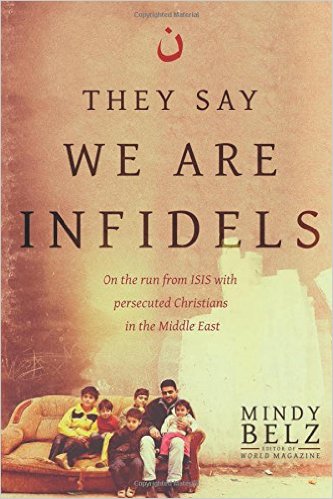
They Say We Are Infidels, a book review by Paula Wilding

Paula Wilding wrote this review of They Say We Are Infidels by Mindy Belz, WORLD magazine editor. This book is available at the Sunday morning Bookstall.

On New Year’s Day, Pastor Josh Stringer preached on Psalm 130 and encouraged us to share our stories of where we have seen God’s care and grace. In her 2016 book, WORLD magazine editor Mindy Belz does just this—the telling of the stories of our Christian brothers and sisters persecuted by ISIS in Syria and Iraq.

Belz has spent years traveling to war-torn areas as a journalist, communing with Christians in the Middle East. In They Say We Are Infidels, Belz shares the conditions and history that has led to where the Middle East stands today, with Christians now continually threatened and killed by ISIS. But Belz’s book focuses mostly on stories of the Christians who she met and talked with during her travels over many years. Belz comments that during her years of covering war-torn areas in the Middle East, her safety and survival were always dependent on those whom she could trust—other Christians. What a lesson for us. Our God—who loves community and is himself in constant community with the Son and Holy Spirit—brings his care to us through others who also call him “Lord.”

While not shying away from the destruction and persecution Christians face in Syria and Iraq, Belz focuses on what should be a prevailing characteristic in all Christians—hope. Belz writes of the Christian community and how many Iraqi Christians risked their lives to help her, transport her and house her. The Christians, while they cannot ignore the constant threat upon their lives, clearly are living for something more. Their eyes are on eternity and on Christ day-to-day. With so much loss and uncertainty, these Christians are centered on the promises of God that will not and cannot change. As Belz commented in an interview, “They have a fearlessness that is admirable and something we can learn from them.”

Belz remarks that when she asked the Christians if they would like to be featured in the book under aliases, none of them wanted their real names changed. The bravery and focus on God of these Christians came when they were forced to choose. As Belz remarked in an article in “By Faith” magazine, “they gave up everything so that they could hold on to the one they weren’t willing to give up . . . their faith.”

Belz is clear that persecuted Christians do not need our pity, but they desperately need our prayers and our advocacy. Not all Christians are called to travel to war-torn areas, but they are called to care for their brothers and sisters in Christ. If you would like to be involved, consider joining the weekly prayer group for the persecuted church, Fridays at noon in C103.

If you are interested in helping our Iraqi Christian brothers and sisters, go to WORLD Magazine’s website and search “Aid for Iraqis.” The magazine has compiled a list of 15 reputable and trustworthy agencies, encouraging American how to help in very practical ways.

Nearer, My God, to Thee by Holly Burke

There are days when it’s good to take a breather from current politics and world affairs and look back at other occupants of the White House such as the twenty-fifth resident—William McKinley. Holly Burke gives us a glimpse into McKinley’s life and death.

President William McKinley was a man of profound Christian faith. He prayed, read the Bible daily, faithfully attended church throughout his life, participated in the ministry of the Methodist church and other Christian organizations, supported missions, displayed genuine compassion for others, frequently testified to his Christian convictions in both public and private, and believed that God directed the course of history and his own life.

 As a Union soldier during the Civil War, the young man wrote in his diary:

“Fall in a good cause and hope to fall in the arms of my blessed Redeemer. This record I want left behind, that I not only fell as a soldier for my Country, but also as a Soldier of Jesus Christ. [His family and friends would be comforted with the solace] that if we never meet again on earth, we will meet around God’s throne in heaven. Let my fate be what it may, I want to be ready and prepared.”

Following the war, McKinley studied law and settled in Canton, Ohio, where he met and married Ida Saxton. The couple had two daughters, one of whom died at age three and the other at four months. Devastated, Ida never recovered from these losses and soon developed epilepsy. McKinley remained a devoted husband to her for the rest of his life. Ida declared in a 1901 interview that few could understand “what it is like to have a wife sick, complaining, always an invalid for twenty-five years, seldom a day well … and yet never a word of unkindness has ever passed his lips. He is just the same tender, thoughtful, kind gentleman I knew when first he came and sought my hand.” According to the Presbyterian Banner, McKinley’s love for his wife was “almost proverbial throughout the nation.”

In 1876, the aspiring politician was elected to the U.S. House of Representatives, an office he would hold for the next fourteen years. He then ran for governor of Ohio in 1891, winning by a comfortable margin. While campaigning for governor, McKinley stated, “I pray to God every day to give me strength to do this work, and I believe He will do it!” Two years later, he was reelected governor by an overwhelming majority. In 1896, the Republican National Convention nominated McKinley for president on the first ballot. The governor conducted his entire campaign from his front porch in Canton, giving more than 300 speeches to an estimated 750,000 visitors. In a hotly contested race, McKinley beat Democrat William Jennings Bryan by a margin of about 600,000 votes. He humbly invoked God’s direction in his first inaugural address: “Our faith teaches that there is no safer reliance than upon the God of our fathers, who has so singularly favored the American people in every national trial, and who will not forsake us so long as we obey His commandments and walk humbly in His footsteps.” On another occasion, he declared, “The greatest discovery a man or a nation can make is to find the truth of God’s Word. More to be prized is it than the discovery of continents, than the discovery of gold mines, than the marvelous discoveries being made in the physical and scientific laboratories of the day. When a man truly gives himself to the study of the Bible he discovers it to be God’s great love story to man. The more profoundly we study this wonderful Book, and the more clearly we observe its divine precepts, the better citizens we will become and the higher will be our destiny as a nation.”

Biblical principles and his personal Christian convictions clearly guided McKinley throughout his presidency. His oath to faithfully execute the office of president was “reverently taken before the Lord Most High. To keep it will be my single purpose, my constant prayer.” Less than a year into McKinley’s first term, a series of complex diplomatic challenges with Spain tested his foreign policy. On February 15, 1898, the USS Maine exploded in Havana Harbor, Cuba. Outraged at the loss of American lives, Congress, the press, and much of the American public constantly pressured the president to declare war. Because McKinley had lived through the gruesome battlefields of the Civil War, he approached the situation with caution. The president quietly explored several other alternatives, including the purchase of Cuba from Spain and allowing Spain to maintain token sovereignty over the island. Both proposals were refused. On April 23, Spain declared war against the United States. Two days later, Congress responded with a declaration of war on Spain.

The conflict itself lasted a little over three short months. After a decisive American victory at the Battle of Santiago, McKinley issued a proclamation of thanksgiving: “[We] should reverently bow before the throne of divine grace and give devout praise to God, who holds the nations in the hollow of His hands and worketh upon them the marvels of His high will, and who has thus far vouchsafed to us the light of His face and led our brave soldiers and seamen to victory.” On August 12, 1898, the United States ratified an armistice with Spain. In December, the Treaty of Paris officially ended the war. Under the agreement, Puerto Rico and Guam became American territories, and the Philippines was purchased for a sum of $20 million. The president justified annexation of the Philippines “to educate the Filipinos, and uplift and civilize and Christianize them, and by God’s grace do the very best we could by them, as our fellow men for whom Christ also died.”

Devoid of personal bigotry, McKinley enjoyed a very cordial relationship with both Protestants and American Catholics during his administration. In November 1899, the president hosted the General Missionary Committee of the Methodist Episcopal Church. He was praised as “a Christian gentleman, … a devoted husband, and a God-fearing American statesman” who was “actuated by lofty motives.” John Ireland, the Roman Catholic Archbishop of St. Paul, paid tribute to McKinley after his assassination: “I knew him closely; I esteemed him; I loved him. He was a true man, honest, pure of morals, generous, conscientious, religious.” Although the political realities of the time prevented McKinley from alleviating the plight of Southern blacks, he stood for racial equality and justice. The Ohioan declared, “Our black allies must neither be forsaken nor deserted. I weigh my words. This is the great question not only of the present, but is the great question of the future; and this question will never be settled until it is settled upon principles of justice, recognizing the sanctity of the Constitution of the United States.” On the subject of voter fraud, he asserted, “Is this system of disfranchisement to be further permitted? Is the Republican sentiment thus to be hushed in the South, and how long? … I answer, No, No! but that the whole power of the Federal Government must be exhausted in securing to every citizen, black or white, rich or poor, everywhere within the limits of the Union, every right, civil and political, guaranteed by the Constitution and the laws…”

In the 1900 presidential election, McKinley stood on an indisputable record of national prosperity and successful foreign diplomacy. Despite the extensive campaign travels of his Democratic rival, William Jennings Bryan, the incumbent received 292 electoral votes to Bryan’s 155. It was the largest margin of victory in thirty years, a testament to the American people’s confidence in McKinley and his capabilities.

Six months into his second term, tragedy struck. On September 6, 1901, while greeting visitors at the Pan-American Exposition in Buffalo, New York, the beloved president was shot twice at point-blank range. His assassin was Leon Czolgosz, an anarchist. The Presbyterian Banner reported that after being shot, McKinley’s “thoughts went out in tenderness to his wife, in forgiveness to his enemy, and in unselfish regard for the public interest.”

One of the bullets ricocheted off the president’s jacket and landed in a pocket, but the other penetrated his stomach walls. At the Exposition hospital, surgeons carefully operated on the injury. While a doctor administered ether to sedate McKinley, the wounded man murmured the Lord’s Prayer. After much gentle probing, the surgeons determined that they couldn’t locate the bullet and closed the wound. McKinley was then moved to the home of John G. Milburn, the chairman of the exposition. Throughout his ordeal, McKinley remained calm, cheerful and patient. All who visited the president were impressed by his serenity. An anxious nation waited and prayed. By Thursday, he seemed to be recovering. Unbeknownst to the doctors, gangrene had been slowly creeping along the path of the bullet. Early the next morning, McKinley suffered a collapse. Around 7:40 p.m., he asked to see his wife. In his final conscious moments, the fervent Christian quoted a few lines from his favorite hymn, “Nearer, My God, to Thee.” His last words were, “Good-bye all, good-bye. It is God’s way. His will, not ours, be done.” At 2:15 a.m. on Saturday, September 14, 1901, President McKinley surrendered his soul to the Savior he had so loved.

Sorrow engulfed the country. Thousands of mourners lined the railroad tracks from Buffalo to Washington, many of whom broke into spontaneous renditions of “Nearer, My God, to Thee” in McKinley’s honor. At the Capitol, thousands more viewed the fallen president’s casket as it lay in state. Two public funerals were held at the Capitol and the First Methodist Church in Canton. Charles Manchester, McKinley’s pastor, declared in his eulogy that McKinley was a Christian “in the broadest, noblest sense of the word… He had gained in early life a personal knowledge of Jesus, which guided him in the performance of greater duties … than … any other American President.” Indeed, he had affirmed that he was only able to faithfully discharge his duties because of his faith in God.

“Where he found distrust, he left faith; where he found strife, he left peace; where he found bitterness, he left love; where he found an open wound, he poured his dissolving life as a precious ointment to soothe and heal,” wrote journalist Harry S. Edwards. Ministers challenged Americans to examine their own spiritual state in view of McKinley’s sudden death. Methodist bishop Edwin Andrews emphasized that the president “based his hope on Jesus Christ, the appointed and only Redeemer of men...” Perhaps McKinley’s life is best summed up in his own words: “[A]ll a man can hope for during his lifetime [is] to set an example, and when he is dead, to be an inspiration for history.”