Be Like George

Kristi Fritz first gave this musing as a devotional at a Mom2Mom gathering earlier in the month.

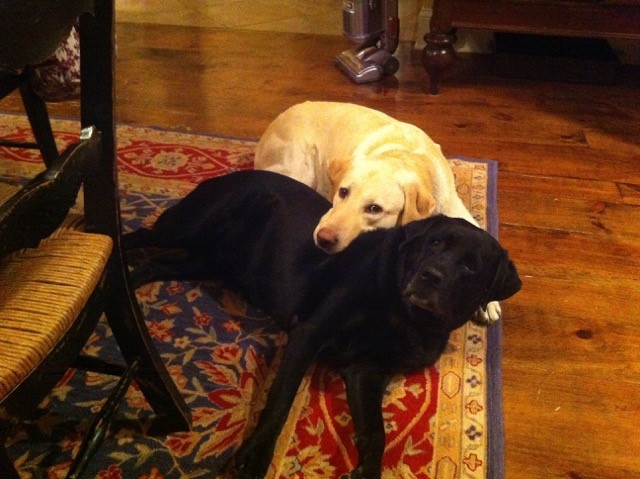
George, the yellow Lab, resting his head on Polly.

George, the yellow Lab, resting his head on Polly.

I am a visual learner and God has graciously provided me with two resident visual aids—my canines, George and Polly, whom I dearly love—to remind me of how I want to live out my relationship with Jesus. This may sound silly, but, I want to be like George.

My dogs are both Labrador retrievers, but that’s where the similarities end. Polly is extremely loyal to me, but aloof to pretty much everyone else in the family. She’s also smart and willful—a dangerous combination in both dogs and people. George, however, is your typical lab. He’s energetic, affectionate and eager to please me and everyone else in the family.

Every day, I take them out to the backyard. I’ll usually spend a few minutes outside with them, but depending on my schedule or the weather, I might head back in the house and leave them outside to play and get fresh air. Dogs need fresh air, right? Wrong.

Because they’re both very loyal to me, they don’t like being outside without me. This is both sweet and annoying. George handles the separation by walking over to the back door, sitting down and looking in at me longingly. If I leave him outside, he will eventually lay down at the door, patiently wait until I let him back inside. When I open the door, he always greets me with joy and kisses. He never seems to be bitter or angry that I left him on the porch.

Polly, on the other hand, gets mad at being left outside alone. She will inevitably find something valuable in the backyard—a toy or umbrella accidentally left outside, part of the sprinkler system, or her personal favorite, potted plants. She will then run around the yard with said object in her mouth until I discover what’s she’s doing and call her in.

At the sound of my voice, she might drop the item and come right in or continue to parade around the yard, hoping I’ll chase her. Or she’ll wander around for a bit until she decides that she’s good and ready to come inside. In addition to the mess Polly usually makes, she also ends up being gated in the mudroom by herself. I still love her, but, how I wish she would just wait outside patiently. Her disobedience makes me sad and sometimes angry. 

Polly does give me pause to think. Is this how I act when God asks me to wait for that answer to prayer? If I’m being honest, the answer is sometimes yes. But my dogs unknowingly encourage me to long to be like George when God asks me to wait. I want to patiently and joyfully trust him, not get bitter and disobedient. 

In keeping with her aloof side, Polly wants to know where I am in the house, but doesn’t necessarily want to be near me. She’ll usually come when I call her, but stop about three or four feet away from me. It’s the craziest thing. I either have to go over to her if I want to pet her or continue to call and coax her until she comes all the way over to me. I often wonder if she realizes how much love I have to lavish on her, if only she would come and receive it!

George can’t get enough of my affection. If I’m sitting on the couch, he will sit at or on my feet, and then put his paw gently on my lap as if to say, “Please, please, pet me.” Sometimes he’ll lay his head on my lap. He will lay down at my feet, content to stay there until I get up. He’s so endearing and has been known to turn friends who are so-so on dogs, into dog lovers, or at least George lovers.

Once during a Bible study at my home, a friend was sharing about something really difficult she was going through. She started crying. George got up from the spot where he had been laying and went over and sat right in front of my friend. He just looked at her lovingly while she pet his head and continued crying. It was honestly as if he knew she was hurting and just wanted to sit with her and offer comfort.

I want to be like George in how I approach my heavenly Father and others. I want to draw near to him, to seek him, to abide in him. He has so much love to lavish on us if only we would draw up close to Him. And as we abide in Him, our lives will produce fruit such as love, joy, peace, patience, all those things we need in abundance with those God puts in our path each day.

The last visual aid is at the 65-acre dog park I frequent with my furry friends. George and Polly absolutely love it there. It’s like Disneyland for dogs. About a year ago, I decided to do a little experiment. We were walking down a trail, when I suddenly veered off at a diagonal into an open field. I didn’t call their names to follow me because I wanted to see how long it would take them to notice my absence. I also wanted to see what they would do when they realized I was on a different path.

It didn’t take Polly long to notice my absence. She looked at me and I was so hopeful that she would happily run to my side and continue our walk together. Not a chance.

After a glance in my direction, she turned back to the original trail and trotted onward. I didn’t know whether to be mad or laugh. I shouldn’t have been surprised because this was so in keeping with her willful spirit, but I still couldn’t quite believe how bold she was in her rebellion. She continued on a little ways, and then I decided it was time to hit the “beeper” button on the remote control I held in my hand that would send a little “beep beep” to her collar.

I called her as I hit it but she didn’t seem to acknowledge me or the beeper; she just continued on her merry way. After a few seconds, I decided I needed to let her know I meant business. I called her name again and hit a different button on the remote that sent a very low shock. No response, not even a turn of her head. I couldn’t believe the depth of her sass.

By now, she had gone a fair distance away from me. Pretty soon the path would turn off to the left and she would be out of sight. It wasn’t safe for her to be roaming around the dog park by herself. So with great sadness, I turned up the voltage dial a little and hit the shock button again while I called her name. This time, she turned her head and acknowledged the slight pain, then reluctantly trotted back to me. I still loved her, of course, but I was so disappointed that she didn’t want to follow me until painful consequences were involved.

I was struck with how often I was exactly like Polly, following my own path and ignoring my Savior’s voice.

Where was George in the meantime? Running around, sniffing happily and exploring his surroundings. Like Polly, it didn’t take him long to discover my absence. But when he realized I wasn’t right beside him, he stopped and looked around, eager to find me. When he spotted me, he got this look of pure joy of his face and came charging at me, full speed!

I had to brace myself because when 90 pounds of dog races towards you and your knees, you’ve got to be prepared. He dodged me at the last minute, as he always does, and then circled back to greet me with love and affection. He continued to explore the dog park, but never got too far from me without bounding back to my side and checking in. He’d look at me with his big brown eyes, tongue hanging out of his mouth, as if to let me know that by my side was his favorite place to be. I was struck again by the profoundness of it all.

I felt like God was using George to tell me that when it comes to following him, I should emulate my joy-filled yellow Labrador. It made me desire to follow God so closely, to stay at his side.

My advice? Let's stop running our own race, set on our own path like Polly, and joyfully follow Jesus. Let’s seek him in his Word and get to know him intimately so that we will know his voice and follow him. He will give us the endurance and strength we need for each day.

Let’s be like George.
My Transracial Journey

By Lorraine Triggs

Newark, Watts, Detroit. Those three cities are linked forever in our country's history with race riots. My husband, Wil, was a child in the Los Angeles area when Watts exploded; I lived about 15 or so miles from the center of the riots in Detroit.

Two weeks before the July 1967 riots in Detroit, my father died, and now my mother watched the city in which she was raised crumble in violence. My suburb was placed under curfew, and when the national guardsmen flew overhead in helicopters, we neighborhood kids would blissfully run outside and wave to them.

One night, a man from church knocked on our door. He held out a gun to my mother and said, "Here. Take this. If a stranger comes to the door, shoot first." My sisters and I stared at my mom. Our family didn't own guns. 

The new widow pushed the gun back to the man and said, "No. We will welcome people to our home and trust God to protect us."

My mom was no Wheaton academic, but her actions taught us more about prejudice and racial reconciliation than any textbook or classroom experience or short-term missions trip ever could.

You see, my mother's maiden name was Horowitz. Her parents emigrated here in the early 1900s, fleeing the Russian pogroms. They settled in Detroit, where my maternal grandfather was a tailor.

Growing up in 1920s America, my mother used to tell us how the Irish kids would call her and her siblings names and throws sticks at them as they walked to Hebrew school on Saturday. We were appropriately appalled on my mother's behalf, until she reassured us that she and her brother and sisters would get even when the Irish kids went to church on Sunday.

She did have some trouble letting go of a thousand-year-plus bias, especially when my sisters and I were running at high speed through the house. "Quit acting like little Arabs," she scolded. (I'd later brag to my college friends that my mother never called us wild Indians when we were misbehaving, but I don't think she'd get away with that today.)

Things weren't always lighthearted. I remember my mom coming home from church one time, visibly upset. She didn't tell us what happened, but said, "Well, you always have to have a Jew to kick around." A sad, but accurate, commentary on life, I suspect, even in our church.

Then there was the comment my sisters and I would hear more than once, "You don't look Jewish," as if it was a disease or a handicap. My mother's advice—smile sweetly and reply, "Oh, really?" Point taken.

Neither overt or subtle prejudice diminished my mother's cheerful trust in Christ and her gracious acceptance of people. She may not have been able to give an exegesis of Ephesians 2:14-18, but she knew and loved the One who destroyed the barrier and the dividing wall of hostility and that was what mattered to her.

I was glad when Pastor Moody did a weekend sermon on Acts 8:26-40, "Racism and the Gospel." Philip and the Ethiopian eunuch have a special resonance for me. Not just because of my mother, but because when it was time to give our son a name, we c hose to name him after this Philip.

Our then-toddler son, Philip, with my mom, Grace Horowitz Lustig.

Our then-toddler son, Philip, with my mom, Grace Horowitz Lustig.

From my Jewish mother to my biracial son, I see the beauty and grace of God's creative hand of love and grace in all humanity.

Truly God's Hand

Poetry by Nancy Weckler

Truly, truly, I have seen God’s hand.

It is holding mine.

Truly, truly his hand has been leading me down the path he has prepared for me.

Truly he has gone before me, and

Truly he is with me step-by-step.

His hand led me here to this church through my friend Beth

His hand led me here to this Wednesday morning Bible study.

In his perfect timing his hand guided the woman I was to meet.

Her name is Julie

Truly, truly his love guided us to this day.

“My granddaughter has been told she has Mast Cell Disease.” I say.

“I have that too,” Julie utters with a tear in her eye.

My heart leaps and I gasp.

She grabs my hand.

I squeeze hers. 

The tissue in my hand is wet with my tears.

“I will write you everything I know about this disease” Julie says.

Give me your email address.

Truly, truly God has led me to this group of prayer warriors.

Truly, he has heard, acknowledged and responded to my cries for help.

Truly, his love has engulfed me with his promises and his grace.

I have seen God’s hand.

It is holding mine.

It is holding Julie’s; it is holding yours too.

Truly, he is holding each of our hands,

As he gently leads us down the path He has prepared for us.

Onward and Out of the Graveyard

In his review of Dr. Russell Moore's book, Onward: Engaging the Culture Without Losing the Gospel, Pastor Josh Stringer poses some strategic questions for those of us who follow Jesus.

Here's Josh's review  that first appeared in Connections, and a disclaimer that Russell Moore is one of Josh's former professors.

Do you feel out of place in our culture? Are you prone to panic over the headlines? Are you bothered that you’re perceived as odd or strange for what you believe? Do you ever wonder why you feel that way? If you’re a Christian, have you ever thought about the strangeness of the gospel you say you believe?

Think about it. As a Christian, you believe that a baby was born to a virgin, and he later walked on water, told the weather what to do and eventually walked out of a tomb after being dead for three days? That. Is. Strange.

And we haven’t even begun to talk about the counter-cultural moral standards that accompany belief in a holy God who would send his Son to die for your sins and then call you to follow him. Let’s face it. The gospel of Jesus Christ is strange, particularly in the face of a growing culture of “the religious nones.”

This is exactly what Russell Moore, president of the Ethics and Religious Liberty Commission of the Southern Baptist Convention, reminds us in his book Onward: Engaging the Culture without Losing the Gospel. Says Moore, “The shaking of American culture is no sign that God has given up on American Christianity. In fact, it might be a sign that God is rescuing American Christianity from itself.” Moore clearly reminds us of what the gospel is and why it matters that we get it right. He is also crystal clear about what the gospel isn’t and, sometimes uncomfortably, points out how we’ve subtly gotten it wrong in the past and why that matters, too.

It might be tempting to mine this book for pithy sayings in order to win a Facebook argument or to accumulate verbal hand grenades to lob at a liberal co-worker. First, if that’s you, repent. Second, you’ll need to look somewhere else to find your ammo.

Other readers might want to find an honest how-to list for cultural engagement. Moore gets there, but not until his later chapters which include, “Human Dignity,” “Religious Liberty” and “Family Stability.” Before you get to helpful how-to’s, Moore leads his readers through a biblical journey of the whys in chapters such as “A Bible Belt No More” and “From Moral Majority to Prophetic Minority.”

Moore will engage your thinking in a lively manner with theological integrity, cultural relevance and Christlike compassion. He also brings a kingdom-centered veracity that is missing from many of our conversations that are often filled with hopeless laments over cultural change. And that’s why you should read this book.

With great hope in Christ, Dr. Moore calls us to flee cultural panic and press forward with the life-changing gospel of Jesus Christ. He boldly reminds us, “The kingdom’s advance is set in motion by the Galilean march out of the graveyard. We should then be the last people on earth to skulk back in fear or apathy. . . . We need leaders and allies, but we do not need a Messiah. That job is filled, and he’s feeling fine. . . . We live now in this demon-haunted earth, but we wait for the demon-conqueror from heaven.”

Strange, indeed. Let’s keep it that way.

Why? (Why!)


Poetry by Alyssa Carlburg

Grief is spoken in words,

Heard through the eyes,

And felt in the absence of the one

Who was lost.

When grief is, they are not.


“Why?” The question whispered from lips,

Spoken to others, and shouted into the darkness.

It drowns despair in anger.

It erects a barrier between man and God.

It demands an answer, but accepts none.

“Why?” is an iron cage around our hearts.
 

“Why!” is Your answer, prayed in the garden,

Your tears of blood mixing with our tears of grief.

It lifts our pain on to Your shoulders.

It is the bridge between us.

It is answer for which we dared not ask.

“Why!” is the promise of eternity with You.


Grief is not understood here, and will not be felt after.

It is temporary; it has been defeated.

It is real, but more so are You.

“Why” is our question, and also Your answer.
 

You are every answer.

I have no more questions.

If You Had to Ask . . .

If this were your first visit to this church, or any church for that matter, what questions would you ask? Beth Kucera, College Church regular attender, had a lot of questions about her first visit to College Church. Any sound familiar to you?

Which Sunday would be the first? Decision made.
What to wear? Sport coat and pants had been selected and sweater and skirt were laid out on the chair.
What time to leave the house?
How long would the drive take?
Do they have a parking lot or street parking?
Should they hang up their coats or take them to the pew?
Will there be a bulletin or will the order of service be on a screen?
Will they be able to see the screen?
Should they sit closer to the front or in the back in case of the need for an easy get-away?Would they know any of the hymns?
Would anyone notice them and shake their hands?
Would they have to sign a visitor registry or wear a stickie “Hi I am New” tag??
What would the sermon be like?  One of those “Ten Minutes Barely Settled in and It’s Over” types or 20 minutes of “Followed It A Few Minutes But Then It Lost Me” ones?
Do sermons every really teach anything about the Gospel anymore anyway? Will the sermon pat them on the head “There, There, You Are Doing Just Fine”?
Has the Gospel really become like swiss cheese?

Below the surface of the questions, came the quiet promises from the Word:
Therefore, do not worry about tomorrow, for tomorrow will worry about itself.  Each day has enough trouble of its own. (Matthew 6:34, NIV)
Trust in the Lord with all your heart and lean not on your own understanding. (Proverbs 3:5, NIV)
Do not be anxious about anything, but in every situation, by prayer and petition with thanksgiving, present your requests to God. (Philippians 4:6, NIV)

A few minutes passed. They sat still and it was so quiet you could hear a pin drop. Praising and singing and praying. Forty minutes of sermon passed like five minutes. Truth heard. No Swiss cheese gospel here—but a service that was full on aged Cheddar and rich double Gloucester.

After the benediction and postlude, they sat stock still.  If they did not get up and walk out now, the next service would start. Would that be such a bad thing?

They wordlessly made their way to the visitor’s table where cheery folks asked, “Can we answer any questions for you?”

No more questions came to mind.