Wayfaring Stranger: ChurchFolk
A song of worship and longing by ChurchFolk, from College Church in Wheaton. Listen and download and share the video.
A song of worship and longing by ChurchFolk, from College Church in Wheaton. Listen and download and share the video.
The month of March begins like it does every season--snow storms and then days that just hint of spring. The sun is shining, you put on your walking shoes, and out the door you go to enjoy the few hours of sunshine before the next blizzard comes along. And with this month comes the crazy college basketball games and the ending of the college wrestling season. March is just loaded with madness, but none seems as mad as the few weeks Jesus spent preaching, healing and praying right before the Crucifixion.
Today, the magnitude of the crowd that followed Jesus would have placed him in the realm of super stardom. Wherever he preached, crowds went to listen. Many more came to be healed or asked for family members to be healed. And Jesus did it all. He healed the sick, he fed thousands with a few loaves of bread and a few pieces of fish, he raised people from the dead. In short, he was becoming Jesus Christ Superstar.
Yet Jesus needed respite from the crush of those who wanted to touch him, but did not really want to believe, truly believe, in what he said about “being the resurrection and the life” (John 11:25). I image that the true hearts of the crowd had to sadden Him. Even his own apostles did not truly comprehend how great the person was they were hanging out with. Soon it would be too late. Soon Jesus enemies would have their way. Yet the time had not come.
In the meantime, many Jewish people had witnessed what Jesus did and believed in him. On the other hand, the Pharisees gathered to plot Jesus’ death. After all, it would be easier “that one man should die for the people, and not that the whole nation should perish” (John 11:50).
So, began Jesus’ last week on earth. He rode into Jerusalem on a donkey. Can you see it? The throngs of people who came out to meet Him? Waving branches of palm trees and singing “Hosanna! Blessed is He who comes in the name of the Lord! The King of Israel!” (John 12:13) The people were praising God for giving them a king, a national leader who would restore their nation to its former glory. Imagine the excitement in the air.
Alas, devotion based on curiosity and popularity fades quickly, particularly when people don’t really listen to what you are saying. They want the easy solution to their problems. Sound familiar? Don’t we still do that today? The people in Jerusalem, like us, would not believe, despite the evidence, that the Messiah was in their midst! How easy it was for them to be manipulated by the religious leaders of their day. Again, how this must have saddened our Lord to know that “every branch in me that does not bear fruit His Father takes away.” (John 15:1) If the people could not abide in Christ and bear fruit, they could do nothing, and their branches would wither. Would you have understood this at the time?
The True Vine knew what was coming, and in his final days warned us about the world’s hatred, promised the Holy Spirit and instructed his followers to pray in his Then Jesus prayed—for himself, his disciples and future believers (that’s us). All this in the few days He had left before He was betrayed, questioned, denied and dragged before Pilate, only to be led away and crucified.
Jesus died on that that cross, to give his life for us. Do you get it? Do you get the madness that can drive people to kill the Messiah, the Son of God, their Savior, upon a tree? To hang upon it, nailed to it, stripped of all dignity for you? Do you see it? When you look at the empty cross in church, devoid of Jesus’ body, can you imagine the scene of that tree with Christ's body hanging from it, dying for you?
Think about the madness of that Passover season of long ago. It wasn’t cheers for a favorite basketball team, but the frenzy of a crowd gone mad calling to crucify Jesus. When March madness comes along each year, remind yourself to not be a part of the frenzy that happened so long ago, and instead remember the power of the cross for salvation.
Three trees
On a hill far away
A safe distance
Unobtrusive
Undemanding
Best kept there
On a hill far away.
Until
The day dawns dark
curtains tear top to bottom
blood and water flow
paradise remembered.
And one tree bends
breaks
demands
my soul, my life, my all
Throwing down my coat
Onto the foot-worn path,
Hoping for a second or two
The donkey he’s riding on
Might step onto it instead
Of the dirty road underneath,
Just a second or two, a gentle
Step, the prized hoof print
Marking the coat,
Forever marred and blessed,
Then scurrying to pick it up
Following him as far
As I can, the sounds of blessings
And hosannas echoing in time,
A connection early in the week
Before he went
where no one else
would, could go.

They say You loved the outcast soul,
The disabled, prostitute, and tax collector,
But what a strange sort of friend You were,
Rebuking even your companions as sinners.
They say You healed and fed the poor,
And condemned the religious leader,
Yet You commanded them to eat the bread of Your flesh,
Proclaiming Yourself the only way to the Father.
They say that those who seek will find,
That we must leave all else to follow You,
But I am tired and burdened with cares,
And I’m too distracted to read Your truth.
They say we must pray that Your kingdom come,
That Your will be done on earth as in heaven,
But I have been building my own little kingdom,
And loving the god of my imagination.
They say You came to bear our sins,
That You died to take our place,
But these words pass my lips so flippantly
And I scarcely feel my need for grace.
They say You had all power in heaven
To lift Yourself off of that tree,
And yet You chose to stay there,
Second by second, in unimaginable agony.
They say You were crucified and came to life the third day,
Though not in some pitiable myth in our hearts,
But in Your very body You walked and You ate.
They say that Thomas doubted that You were truly raised,
But do I believe that I, too, will be raised,
And with my own fingers Your wounds I will trace?
Just who do You say You are,
Prophet, Priest, and King?
Son of David, yet David’s Lord,
Messiah, yet it is Your death that sets us free?
You’re the second Adam, yet eternally begotten Son,
Submissive to the Father, but given all authority on earth.
You are God and also man,
A friend, and yet an offense—
Your jagged edges cut me, and yet Your love hems me in.
Who are You, Jesus, and what do You want of me?
Everything, that is all.
My LORD, my GOD, my risen KING.
I was pretty much a city boy, and growing up in a military officer’s home, I lived in places such as Whidbey Island, Norfolk, Alameda and San Diego. But now, as a new seminary grad, my wife, Lois, and I were in our first church, and I was becoming acquainted with things like pheasant hunting, calf pulling and almond harvesting. To tell you the truth, at the time, I couldn’t tell a pistachio orchard from a walnut orchard from a prune orchard from an almond orchard.
But all that was about to change and, as it did, I learned something very important about the Christian life.
Every time I hurtled down orchard-lined Highway 32 between Orland and Chico in Northern California, I noticed a curious brown line on each tree trunk and would wonder why the trees had those dark lines. The best answer I came up with was, “there must have been a flood here at one time and it discolored the bark on the lower part of the trees.” Wrong.
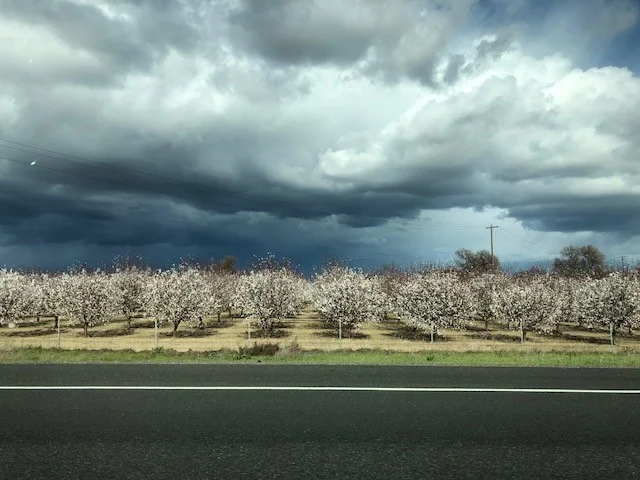
When I shared my hypothesis with a rancher friend of mine, he laughed out loud and called out to his wife, “Margie, come hear what our pastor just said.” I knew I was about to get a lesson in Agriculture 101. I did.
That mysterious “line” was really the demarcation between two different types of walnuts grafted together to make one tree. The Paradox walnut is used for the root stock, as it has the best root system for absorbing water and nutrients from the soil. The Chandler walnut is used for the scion, the shoot grafted into the root stock when the tree is still young, as it is superior for bearing nuts on its branches.
Clever these ranchers are, getting the best of all possible worlds.
One day I knelt in the dirt on a cherry orchard and watched an arborist carefully grafting some trees. He made a slit in the root stock with the sharp blade of his knife, cutting at an angle through the outer bark into the heart of the young tree. Then with a flick of his wrist he made a similar cut in the scion. He carefully joined the two exposed flaps of the root stock and scion, added some gluey pitch and wrapped them in tape. It was all done in less than one minute. On to the next tree.
“That will never work,” I muttered to myself. “Two pieces of wood held together by glue and tape?” But it did. A few years later, I stood in that same orchard as my friend Bob watched truckloads of his cherries head down Interstate 5 to the Stockton shipyards. Those cherries, the first to ripen in the United States, fetched an amazing price when they landed in Japan within 24 hours.
Grafting: “a horticultural technique whereby tissues of plants are joined so as to continue their growth together.” Defined by Wikipedia. Invented by God. Used by ranchers world-wide.
Three lessons. First, security. If you are a Christian, God has grafted you into Jesus Christ. Through the miracle of repentance and faith, a small slit was cut into your soul and you were joined to Jesus in a living union. His life is now in us. We are “hidden with Christ in God,” (Colossians 3:3) “joined to the Lord” so that we are “one spirit with him.” (1 Corinthians 6:17) Because we are “in Christ” (the Apostle Paul’s favorite description for believers), “neither death nor life, nor angels nor rulers, nor things present nor things to come, nor powers, nor height nor depth, nor anything else in all creation, will be able to separate us from the love of God in Christ Jesus our Lord.” (Romans 8:38, 39) We are secure, knowing that in the right hands, grafting works.
Second, expectancy. Farmers expect their grafted trees to produce fruit. So should we. “If you abide in me, and my words abide in you, ask whatever you wish, and it will be done for you. By this my Father is glorified, that you bear much fruit and so prove to be my disciples. As the Father has loved me, so I have loved you. Abide in my love.” (John 15:7-9) We are expectant, knowing that as we live in trusting, loving dependence on Jesus, we will bear fruit.
Third, humility. God in his mercy has joined us, Gentiles, into the rootstock of his covenant promises to Abraham. That should keep all of us humble. “But if some of the branches were broken off, and you, although a wild olive shoot, were grafted in among the others and now share in the nourishing root of the olive tree, do not be arrogant toward the branches. If you are, remember it is not you who support the root, but the root that supports you. . . .They were broken off because of their unbelief, but you stand fast through faith. So do not become proud, but fear.” (Romans 11:17, 18, 20) We are humble, recognizing that God in his mercy has included us in something way beyond what we deserve.
A few weeks ago, I returned to visit friends in Northern California. Traveling down Highway 32 brought back many memories. But when I drove past that old familiar walnut orchard and saw the familiar lines on the trees, I wasn’t wondering if an imaginary flood had made the lines.
Instead, I prayed, “Thank you, Father, for grafting me into your Son”—my heart filled with security, expectancy and humility.
Steve is a College Church missionary with Training Leaders International, teaching and equipping pastors globally. Steve and Lois live in West Chicago and are involved in a variety of ministries at College Church.
About 15 years ago I gave my wife, Elsa, a pink dogwood tree for Mother’s Day. The kids and I planted the tiny tree in the front yard and waited impatiently for gorgeous flowers to bloom.
One year passed, then two, then three. Still no flowers. We wondered if the spindly little dogwood would ever grow and blossom. A few times I was tempted to cut it down.
But one spring we saw some blossoms, and more in the springs after that. As time passed, the trunk thickened, branches expanded, and an ever-widening array of pink petals spread among the leaves. Truly our pink dogwood was coming into its own.
Our experience with the dogwood tree reminds me of our attitude toward ministry sometimes. We invest our prayers and efforts in helping a friend or family member grow in their faith.
But if we aren’t seeing results, we are tempted to give up and move on to someone or something else.
If that is you right now, just keep on “watering the tree” and wait for God to work.
For Instance, I’m involved in a ministry of equipping Christian writers and publishers around the world. We come alongside a man or woman with gifting for Christian writing or publishing. We nourish that talent through training, encouragement and prayer. Sometimes we wonder if, or when, all that hard work will bear fruit in a finished book or established publishing ministry.
Then that writer’s book does get published, that publisher does makes real progress toward growth, that trainee does becomes a trainer of other writers and publishers. And we remember that it takes time for a growing Christian communicator to take root and blossom.

Last summer our little dogwood tree had one more surprise for us. There on a branch just three or four feet off the ground rested a bird’s nest. Inside sat a mama robin alongside her baby, beak open and expectant for food. We could hardly believe it.
Seeing the bird family, I was even more relieved that we hadn’t given up and removed the tree from our front yard. Not only was the dogwood providing beauty, it was giving shelter to new life, as it were.
It was a fitting conclusion to this parable of the dogwood tree….coming full circle to illustrate how God’s Word is working even when we can’t see it at first.
“What shall we say the kingdom of God is like…..? It is like a mustard seed…when planted, it grows and becomes the largest of all garden plants, with such big branches that the birds of the air can perch in its shade” (Mark 4:30-31).
