Rock of My Salvation by Cheryce Berg

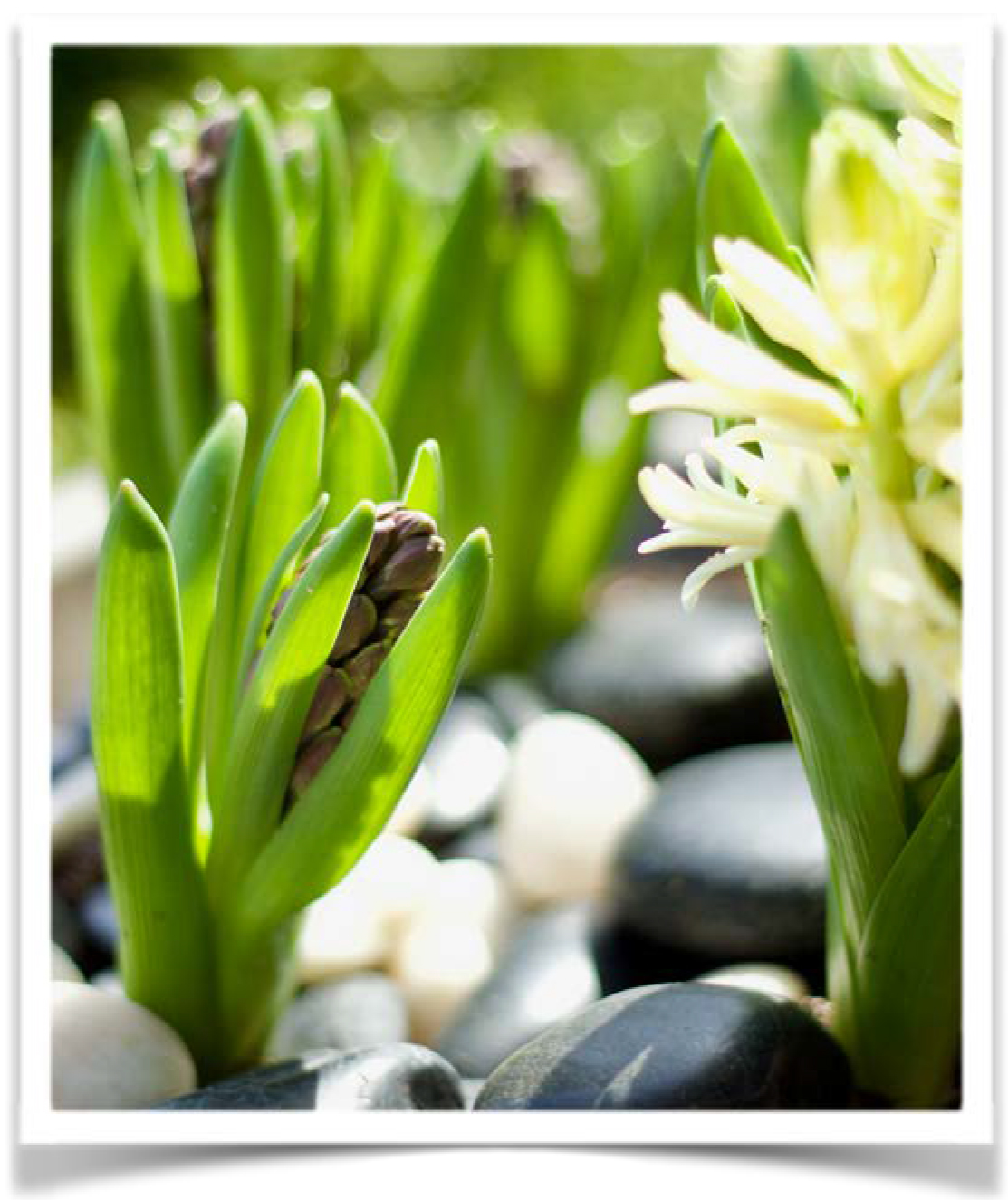
Winter wanes and spring struggles. My faith mirrors the hyacinths outside my front door, straining up through cold stones looking for sunlight.

Easter catches me by surprise and I admit my heart is not ready to celebrate Holy Week.

I stop by to visit my friends Pete and June, newly returned from their first trip to Israel. Maybe what they saw there will enliven my weary heart. Surely walking where Jesus walked brings new life to Easter, even when you’ve celebrated it for almost ninety years, as they have.

I want to be refreshed.

Pete talks about the land. “But the land, you wonder how they can live in a land like that. Basically, you see rock and sand. . . You see trees by the thousands--fruit, bananas, figs, olives, apples, pears, everything you can think of. You would think the land cannot produce but it does. The land is an amazing land. I don’t know how it could produce the way it does.”

He keeps circling back to the land—and the rock which makes it. “It’s a beautiful country in a way. In another way, it’s probably not a beautiful country at all because there's so much rock and sand, but they seem to thrive on it so well. Amazing. Just amazing.”

And again, Pete remarks on the rock and land. “We would see sheep up in the mountains, going up there, with almost no grass.  But they would work what little there was.”

It sounds parched. Not refreshing at all. Not what I was envisioning.

Yet, in an upside down way, it is. I start thinking about those trees and sheep Pete and June describe, thriving in the rocky desert.

I decide to look and see what God does with rocks and stones in the Bible. 

I immediately see that water bursts forth from the rock for the Israelites at Horeb. Moses is hidden in the cleft of a rock as God’s glory passes by. God’s law is carved on tablets of stone. Stones adorn the priestly garments. Stones are set up as remembrance of God’s mighty hand and built into altars. David’s stone kills the Philistine giant. Solomon’s temple is constructed of huge, costly stones. God is called the rock, often combined with words such as salvation, fortress and refuge.

God promises a rebellious Israel that he will take their heart of stone and replace it with a heart of flesh.

In the New Testament, Jesus Christ is described as the cornerstone. Stubborn Peter is the rock on which Jesus declares he will build his church.

And with Easter this week, I can’t ignore Jesus’ death and resurrection. The rocks are split at Jesus’ last cry. He is buried in a tomb carved out of rock and sealed with a stone. And it is this stone the angel rolls away, to reveal a resurrected Savior.

What message do I read in all these biblical connections to a land of rock and stone? I see a God who takes what is not alive and gives it life-giving purpose. He reveals glory, gives law, adorns with beauty, commands worship and remembrance, destroys the enemy, saves, protects and hides—all with rock and stone. He replaces hearts of stone with flesh, builds his church on rock, splits open rocks at his death.

He breaks free from a tomb of rock sealed with stone to be my Risen Savior.

Pete and June’s description of a land of rock and stone helps me see that God takes what is barren and breathes life into it. He chose Israel as the promised land, the place where he would send his Son, knowing its terrain.

God didn’t reject Israel because it was barren; he redeemed it in its barrenness.

Just like he did, and does, with me. 

My faith is refreshed at last. God has redeemed my heart of stone with Jesus’ work on the cross. I will worship him this Easter, the Rock of my Salvation.

Saturation Point by Lorraine Triggs

Easter egg dying is a weeklong project in our house. We begin dying eggs the Saturday before Palm Sunday and end the Saturday before Easter.

No Paas egg dye for us; instead we (or at least my husband and two good friends) create works of art with Ukrainian egg dyes, styluses and beeswax. Dipping a stylus heated by the flame of a candle into beeswax, we can make lines, circles and all kinds of varied colors. As the week goes on, dark colors cover up the lighter ones. Since each dye color saturates the egg, the trick is to remember the sequence of dyes—from light to dark—as you apply the beeswax to your egg to create its design.

The final dye color in which we dip our beeswax covered egg is black. The entire egg, with its beeswax designs (squiggles in my case) and layers of color, is completely saturated with the darkest dye. The egg starts white and by Good Friday, ends black.

The fun comes when we melt the wax over low heat, and carefully wipe it off the egg to reveal the design under the black dye and wax.

I've gone to plenty of Palm Sunday (and Good Friday and Easter) services with my hands stained from the dye. The dye eventually fades, but on Palm Sunday, no matter how loud I shout, "Hosanna," my heart remains saturated and stained with sin.

And none of my good works or self-efforts can wipe off the stain. I need another color, a crimson stain, to cover my sin. I can't even cover it myself. And it needs to soak into my heart, mind and soul to create a new life in me, a workmanship created in Christ Jesus.

Now that's worth shouting hosanna as I look to a cross outside the city.

A House Full of Cares by Virginia Hughes

A hoarder lurks between the layers of despair. My niece, Kay, was a hoarder. She hoarded enough things to fill an entire house. She knew the love of God and family. We cared about her. We aren't sure why things got so bad for her. It is certainly beyond us now, and the sad cliché, “too little too late,” rattles in my head.

When Kay stops inviting family members or friends into her house, it is disquieting. Too many times she uses the same excuses:

It’s too messy, I'm too busy, not today.
There are repairs making a mess everywhere.
I’m making props for the church play and stuff is everywhere.
The carpet is being replaced and stuff is everywhere,

Meanwhile, Kay continues to collect other people's junk. Boxes of discards find a home in her house too many times. Old furniture and several boxes of rubbish fill the garage after Grandma moves to the senior home. No doubt the items may work as props in an upcoming play. Nothing wrong with re-purposing things. She hunts down deals and uses coupons like other frugal people. The stacking continues.

Kay catches a bad cold that settles into a deep cough, but insists she is doing okay. Months pass, and she is still coughing. Brows furrow and uneasy feelings grow among friends and family as Kay promises to see a doctor between coughs.

One day, Kay’s mother drives her home and asks to use the bathroom. Kay refuses, exits the car and rushes inside the house. Her mother is left outdoors knocking and calling out to no avail. This story compels me to think that I would knock the door down. I'm a battering ram kind of mother, no door is getting between me and my stubborn child. But this mother let her adult daughter be. She did not beat the door down. None of us beat the door down later either.

Kay is a grown woman. It's her house, and she can keep it as she chooses, but she is hiding something in there. So what, if she likes to collect too many things? Whose business is it that she’s a pack rat? Not ones to force one’s way in, siblings had stopped asking to come inside her home. Kay joins the family gatherings at local restaurants or other relatives’ homes.  None of her four siblings nor her mom enter the house while time passes. Life takes over. The issue, “What is going on in your house?” stews on a dismal back burner and Kay is still struggling with that terrible cough.

Then one day, after work, Kay faints in the parking lot by her car and a coworker calls an ambulance. Kay never regains consciousness and dies a few days later in the hospital. The shock of her sudden death reverberates throughout the family with a crashing jagged rhythm. We gather to mourn her in the church. It is all so sudden; unexpected. We are haunted by the loss of her.

Opening Kay’s front door reveals the enormous piles of stuff filling all the space in the house.  A clear path is not obvious beyond the towers and stacks. The bedroom is impassable as are the hallways. Each room is filled to overflowing. Blanket and pillow reveal her bed, the living room sofa, spilling over with old pizza boxes and used paper plates. Numerous shopping bags have items with tags still on them. Every room has piles of broken junk mixed with new things. The family pulls the house apart, carrying most of it to a rented dumpster while processing their own layers of anger and regret.

Most perplexing are the boxes full of unwrapped gifts in groups of five. Name tags on packages identify her three sisters, one brother and her mom. Under the gift wrapping there are flat screen TVs, dated computers never opened, various tech related gifts, clothing, and household goods. Thousands of dollars spent on gifts she never actually gives them. Her brother remembers a discussion about an item he unwraps. Apparently, she buys items in groups of five not wanting to leave out any of them.  Kay is generous. There are several sets of these gifts. Why has she never given the things to her loved ones? What is she waiting for?

Her personal anxieties manifest in throwing no thing away as it may be needed later. Professionals write volumes about the anxiety-ridden complexity a hoarder lives within. There is professional treatment available which is met with varying degrees of success.

Keeping gifts instead of giving them stems from worrying too much that a chosen gift is not suitable. Better deliberate some more and keep the item for another time. Keeping all sorts of things becomes important. Eventually nothing is thrown out. Trash is saved as one loses track of value, and worries increase that something of value may fall into the trash. Better save it all. The inward and outward life is a swirl of confusion. Holding onto things brings a sense of comfort while it strangles the holder.

The never opened gifts, such as technology items bought years ago don't appear to have been plugged in or used. They are outdated and not useful now. In this case, thieves do not break in and steal, but moth and rust do corrupt, and mice in various stages abound throughout the mess.

It takes several weeks to clean out the house. If you've never watched television shows like “Hoarders,” or “Buried Alive,” don't start now. The problem is repulsive and heartbreaking. The whole scene clashes with one’s righteous desire for cleanliness and order. It is painful to witness a hoarder falling apart as a piece of trash is taken from the hoard. Even if children are suffering, marriages ending, and lives are obviously breaking beyond belief, anxiety over losing a shred of the hoard overwhelms the hoarder. The line between what is useful and what is trash has long been blurred beyond recognition. “One man’s trash is another man’s treasure,” is all depressing rubble made of wood, hay and stubble.

The family is stricken that no one knows how desperate things are for Kay until now. There is never a rock ‘em sock ‘em intervention to fix her as seen on TV. We can't help but blame ourselves for not fixing her; even knowing she didn't want help when offers were made. We believe she loves the Lord, but where does this hideous mess fit into that? A lethal combo this: anxiety, mental illness and desperation. We can't help but feel we let her down. We weren't there for her in the right way. She has such a void to fill, it can never be filled with things which pile up to sicken and enslave her. They are part of the lie belonging to the Prince of Lies.

Am I my brother’s keeper? Yes. And you are your sister’s keeper and your niece’s and your neighbor’s keeper too. I face it. There are times when I am doing a lousy job of it. I can't do everything, but I can better care. We wish we had broken through the front door so we could at least say, “Remember that day we cared so much that we broke down Kay’s door?”

After several rounds of frustration and many dumpsters later, the weeks pass. The family feels distraught and relieved as voices echo throughout the empty house now free of all the clutter. Amidst hugs and tearful promises to stay in touch, the metal FOR SALE sign remains to rattle in the vacant front yard.

The true end of the story is hope waiting patiently for love at the end of our weak passage. In the midst of human weakness, love breaks through. Love breaks through death to surround Kay with the eternal care for which she longs. She believes in Jesus. Therein lies hope enough for all of us. Enough grace to quiet a rattling care.
Before Cares Are Cast--poetry by Virginia Hughes

If I am loved with an
everlasting love,
it is finished.
And so am I,
if the best that I can
offer is myself.

Doubt blinks
focus into blur.
Worry counts care, 
better formed in prayer.

Not for striving,
climbing, falling.
Not to answer,
am I pleasing you each day?

But to simply know the
One who loves me,
Unborn yet purchased
by precious blood.
How well I am loved,
how well.

Know it.
Know it completely.
Know it every day.

Remembered
before I forget, 

Found
before I seek,

Quenched
before I thirst,

Calmed
before I quake,

Soothed
before I ache,

Healed
before I break.

For love has caught
my tears that fall,
before I cast my cares.
Before, the throne of grace above,
True love has caught it all.

The LORD appeared to us in the past, saying: "I have loved you with an everlasting love; I have drawn you with unfailing kindness. Jeremiah 31:3 (NIV)

Cast all your cares upon him and he will sustain you. He will never allow the righteous to be shaken. Psalm 55:22 (NIV)

TEARS in a Bottle by Virginia Hughes

In the early 70's, Jim Croce released his hit, "Time in a bottle," you may remember the nostalgic, wistful words about there not being enough time to spend together, but how important to know the one you want to go through time with. Look it up and you'll find the song remains relevant. This longing for more time with a loved one becomes more realized as one ages. 

You may have seen a ship in a bottle, and know the intriguing magic to make that happen. Maybe you've put a message into a bottle, and thrown it hopefully into the tide never knowing if it will reach someone on the other side as it's carried out to sea. 

But have you ever thought about tears in a bottle?  David mentions this idea in Psalm 56. He is caught by enemies and afraid. As he talks to God he is crying. He notes that these aren't the first tears he has shed and reminds God of this fact. 

Remember, David is a mighty warrior. With God's help, he has taken down wild beasts like lions. He has slain a real giant. It is compelling how David, the fighting man, is tender in his downtime. David is unique in his ability to express himself. This verse is a glimpse into the faith of a man after God's own heart. Verse eight provides insight into David's understanding of God's care. He says, "You have put my tears in your bottle. Are they not in your book?" God, who can do anything, surely keeps David's tears in a bottle. What a beautiful picture of the intimacy between David and God. What a powerful prayer we may all know and practice, "You have put my tears in your bottle. Are they not in your book?" 

David knew who he wanted to go through time with. If you feel alone today, know you are not alone. Even if you sit in what seems like an empty room. God’s spirit is here. The comforter is with you. You are loved by God who is so close that he collects your tears and saves them in a bottle all counted in his book.

Jehovah Sabaoth, the Lord of Hosts Is Our Protector by Nancy Tally

I want to tell you about a very dark night that blazed with light. What you saw all depended on your perspective.

The man I married traveled for work. He would usually leave after the Sunday evening service and return the following Saturday morning, Friday evening if I was lucky.

I developed my self-talk early on. Even though I felt safer when he was home, I really wasn’t any safer than when he was gone for it was God who protected us both at home and on the road, separated or together. (Someday I will tell you about the miraculous near misses I have been in on the road.) Occasionally God reminds us what he spares us from all the time. Keeps our prayers real and honest and prevents them from becoming rote.

Back to the dark night.

The kids and I were home by ourselves. I had them all tucked in bed asleep and was ready to turn in when I heard a Popoid toy skitter across the wood floor of the living room. Popoids made a distinct sound and they did not move under their own power. Unfortunately, the only phone was downstairs in the kitchen on the far side of the house.

We lived in a tri-level home, and the upper hall from my bedroom, across to and down the stairs, was open to the living room. The lone light burning that night was at the top of those stairs. As I descended the stairs, a sense of evil grew until it was totally pervasive and I ducked behind the first cover I could find—an overstuffed chair. There I cowered for what seemed like an eternity. I wanted the phone, but to get to it, I would be fully exposed by the light to the un-curtained  windows of the front door. I wanted to get to my babies upstairs but then I would be exposed even longer, long enough for a clean shot. So, I cowered behind the chair on that dark moonless night and prayed harder than I had ever prayed before. I continuously begged God to protect my family from the evil I sensed all around me.

I could not tell you how long it was before the sense of evil lifted, and I ran upstairs to go from sleeping child to sleeping child checking on their well-fare and rearranging their covers. I thought I would never get to sleep but God tucked me in that night. It was as if he kissed my forehead and said, “Sleep well my child.” I slept soundly till the phone rang the next morning—the first of seventeen calls. Every caller wanted to know the same thing: Were we okay and what happened? God had raised seventeen prayer warriors from their sleep to pray for us. I had nothing to tell other than that sense of evil surrounding me in that pitch-black house with its solitary light. We did not know what had happened.

I have often wished that an artist could paint that night for me, perhaps a cutaway of the house all dark and the kids sleeping in their beds while I crouched and prayed behind the chair. And then paint what I did not see. The blaze of lights and glory.

To make sense of this for you, I need to introduce you to the “Old Man from the nursing home.” The kids and I never knew him by any other name.

We had been watching out for him. He would walk to the corner by our house and wait for a friend to drive by and offer him a lift. Some days he stood there for hours. One 100-degree summer day, we agreed that if no one came in fifteen minutes, we would pile into the van and offer him a lift. That one day had turned into two years. His destination was always the local VFW bar about a mile away.

We had given him a ride the day that turned into the dark night, but had not seen him for two weeks since and wondered if he were sick or even alive.

Then there he was again on the street corner. We piled into the van to pick him up. This time things were different. He wasn’t just the grumpy old codger who grudgingly thanked us for a lift. He was so scared that he blanched at the sight of us. He was not going to get in the van until he had assured himself that we were not ghosts and even then, he was reticent.

But he did get in the van, and then asked me “How did you know?” I inquired how did I know what? He replied “How did you know they were coming?” I didn’t know what he talking about and told him so.

The old man told me that the last time I dropped him off at the VFW about nine men who had long been upset by my bi-racial marriage and children had worked up the nerve to come slaughter us all.

They left the old man at the bar as they slunk up the street and hid in the weeds in the empty field across from my house as they firmed up their plans.

When they returned to the bar the old man inquired, “Did you do it?” While they drowned their fear and confusion in alcohol, they told him no. As they laid in hiding to assess the situation, they saw the house ablaze with bright lights inside and out. On top of that, they counted seventeen big burly men in white suits roaming about both inside and outside the house. They couldn’t understand who had told me they were coming and where I could have recruited all those men to defend the house. They were out numbered and would get caught so they aborted their mission.

The old man asked again and again to find out where all the men in white came from. I had nothing to tell him. It took me a while to put it all together—longer than our short ride to the VFW. Besides I was a bit in shock after all he had just told me.

We seldom saw the old man after that, and when we did, his friends would quickly pick him up and drive off. As for the rest of the men if they ever tried again the Lord did not let me be privy to such knowledge.

So, I say it again Praise be to Jehovah Sabaoth, the Lord of Hosts who is our protector.

Other poetry by Ashley Barney

The truth in science has had the last word:

You are not an inhuman form,         

Some part of me, 

Mere tissue and bone,                    

But every cell of your body

Cries out in its unique code 

That you are not my own,

But wholly other. 

Though this mystery            

Is far too grand     

For any of us to comprehend,

It is a beauty that in

God's mind

I should be a human vessel

In whom to weave a person

Who, though within me, 

Is not me.    

My freedom and worth

Are fully known

When I surrender

To the Holy Other

Who declares the value

Of my life and yours, 

That you have a purpose,

An identity, and soul. 

Though time may tell 

If I'll be poor or alone,

What good is gaining all the world 

If I become poor in soul? 

We are far more than matter, 

We are embodied soulish beings,

My life is so much more than success

Or any measurable thing.

And though I have no power or fame

To give you all I wish to give, 

Life you've already been given, 

And so, my child, you shall live. 

We will be rich in laughter and in tears,

In pages of books and stories of old,

We will feast on love, rich in eternal hope. 

God created you, 

O human other,

And in that one instant

I became your mother.

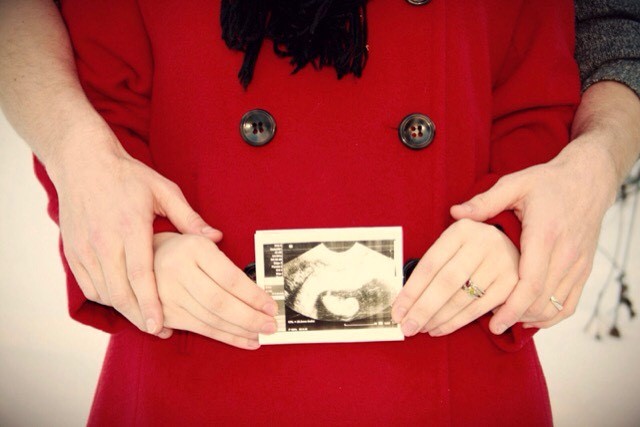
Ashley and her husband, Jason, are expecting their first child, a baby girl, (pictured on right) in July. The title of Ashley's poem reminds us of the otherness of a holy God and the otherness of an unborn child as a unique human created by him