The Faces of God's Global Work by Jeff VanDerMolen

Jeff and Ann VanDerMolen serve with Kids Alive in the Dominican Republic. Jeff first shared this story at College Church's Spring Missions Festival. Jeff's story, and others like it, were printed in the festival guidebook, giving us glimpses of how God is at work around the world.

What is God doing in the global church?

As I think about this question and what we have observed in our 20 years living in the Dominican Republic, a series of faces come to mind. What I see God doing in his church is utilizing people to impact the lives of others. Ordinary people. People who may seem unprepared and inadequate, like I am. People who take bold steps of obedience to God and despite not being fully prepared, step out to do what God has called them to do.

I'd like to introduce you to a few of these people.

Carmen is the cook at our ANIJA school. Every day she cooks for more than 300 kids. She cooks in enormous cooking pots on top of a giant three burner stove. She goes through more than 120 pounds of rice a week. Carmen knows how to cook in quantity, and she has been doing it for more than 20 years. I've done the math: she has cooked 750,000 plus meals as an act of service in her ministry to the ANIJA kids. And in her spare time, she cooks in the evenings for the visiting work teams from North America. If you come to Jarabacoa, you will meet Carmen as she prepares your evening meals.

Carmen is one of my heroes. She has a servant's heart and a quick smile. She is involved in the lives of the kids, her neighbors and those she comes in contact with. God has used Carmen to impact the lives of those that she interacts with.

Jessica teaches second grade. When she was young and living in a broken home in a poor barrio neighborhood she was invited to church by her neighbor Carmen (yes, that Carmen, the cook). Jessica came to know the Lord and looks to Carmen as her spiritual mother. Jessica entered the ANIJA school and graduated from eighth grade. Jessica continued on through high school, and with the help of a Kids' Alive scholarship, went to university, graduating with a teaching degree. Jessica has various options of where to teach, but chose to return to teach at the ANIJA school, whose focus is working with at-risk kids. She knew what it was to sit in these classrooms as a child coming from a hard situation. Jessica has chosen to invest her time and talents to impact this next generation of kids who are growing up in the ANIJA school.

Nojean teaches French and tutors in one of Kids' Alive's school in the Dominican Republic. This might not sound unusual, until I tell you that Nojean is Haitian. There are more than a million Haitians living in the DR, many of them here without visas. They live in some of the poorest conditions, receive the lowest wages and work some of the hardest jobs. Life is not easy for them. Yet there is a vibrant church within this community. Each week as my family and I drive to our Spanish speaking church, we pass a church building where the Haitians meet to worship in Creole. Their service starts before our church service and ends after our service ends. They know how to worship.

During the day Nojean serves in ministry to at-risk in the Kids Alive school, and in the evenings and on the weekends serves as pastor of this Haitian church. He makes his living as a teacher, but chooses to serve as an unpaid pastor. This is common in the DR--bi-vocational pastors who meet their financial needs through a day job; then serve as church leaders as part of their ministries. Nojean has a heart for at-risk kids as well as the Haitian population living in the DR. Nojean is an example of a typical pastor in many parts of the global church, a job during the day and ministering to a church body in non-working hours.

When I think about what God is doing in his global church, I see the faces of those that he is using to accomplish his tasks. He is using ordinary people to do extraordinary things, people who are affecting the lives of those around them in obedience to God.

Chaos Christianity by Wil Triggs

With missions festival upon us, I can’t help but think of Gökhan Talas, a Christian who is publishing a Christian magazine in Turkey. I met him at LittWorld 2015. He came to our prayer for the persecuted church group a few months back. (The picture is of Gökhan and me after the prayer group.) In anticipation of this week’s prayer meeting I asked John Maust if he had received any recent updates, so he sent me some. I’ll share a few with you now.

Gökhan describes 2016 as “a blessed, grateful, harsh and chaotic year. It was a complete disaster for our country.” As a Christian, he has never felt more of a minority than now. People are nervous, anticipating some kind of regime change in April. 

News reports have covered the struggle of Turkey in handling or not handling the flow of refugees. For his part, “We are planning to make a digital Arabic/Kurdish version of Miras magazine. This is very important for reaching the refugee society in Turkey. The government has blocked physical services to refugee camps five months ago, and most of the Christian aid organizations are under pressure. We want to share the gospel in a direct way.” 

Besides planning for this, his publishing team is also working on two book projects, developing gospel-focused seminars for the spring, continuing publication of the magazine, and Gökhan is also visiting churches in unreached areas, preaching in some of those churches and making connections for evangelism services and outreach.

“Our magazine and publication team is still in need of an office,” he reported. “We are still under the budget and praying for new possibilities.”

How does someone do all of that with no office space, in a country where everything seems to be in upheaval and his evangelical faith is greeted with hostility and violence? How do you move forward on projects and outreach with no office space or budget? 

Personally, I don’t know. It's so not me, so not United States. So foreign. But I find inspiration and encouragement that even when Gökhan is facing a chaotic country and a hostile world, he is still praying for new possibilities. As we look ahead for whatever we face today and in the days ahead, may we have that kind of faith!

Gökhan’s update ends with words of thanks and gratitude and says everything they do depends on God’s purposes and the prayers and support of his people.

Watch the short video I made at LIttWorld where Gökhan talks about his magazine and pray with me for him and his heart for the people of Turkey.

Hope Is Alive and Well . . . in Jesus by Pat Cirrincione

W.

Cubs win! Cubs win! For years and years and years, Cub fans hoped their beloved team would win a World Series, and we finally saw it happen last fall!  The joy! The ecstasy! Our beloved Cubbies finally overcame the Billy Goat’s curse. People danced in the streets, hugging one another as tears of joy ran down their faces. What a glorious time it was!

Actually, this is a sign of what hope isn’t. It isn’t wishing for your favorite team to win the World Series. It is not a hope or wishing for what we cannot have (for example, a voice like Frank Sinatra or Celine Dion when we are tone deaf or being the winner among hundreds in a hog calling contest). It is not hoping to be someone God did not design for you to be.

It is also not wishing and hoping or expecting something from our family members that they cannot give. How can we, in our brokenness, expect what they cannot give in their brokenness? Nor is hope hungering and thirsting for the things that can never truly satisfy our worldly wants and desires.

So, is hope an illusion? No, but that hope I just described will leave us empty inside. A Christian’s definition of hope is grounded in the Word of God. Hebrews 6:19 states, “We have this hope as an anchor for the soul, firm and secure.” We have the hope of God’s promises, which are absolutely trustworthy! Our hope in Christ guarantees our safety because we are moored to God himself. Not a prize we have won or a fleeting career on stage or a trophy that is nothing more than a symbol of a passing fancy.

We Christians have been given many gifts, and the gift of hope shows itself throughout Scripture. We have the hope of never being abandoned (Acts 2:26); of hoping patiently for what we do not yet have (Romans 8:25); the hope that if God is with us, who can be against us? (Romans 8:31). We have hope because Christ was raised from the dead, and our preaching and faith is not useless. First Thessalonians 4:16-18 reminds us that “we know that the Lord Himself will come down from heaven and the dead in Christ will rise…and then those alive in Christ…”

As Christian believers, we place our hope in the living God, the Savior of all men (1 Timothy 4:10). Christ Jesus is our hope (1 Timothy 1:1), and we rejoice in the hope of the glory of God (Romans 5:2). We have hope in God, the hope of the resurrection--true biblical hope. A God of hope who fills us with all joy and peace as we place our trust in him, so that we may overflow with hope by the power of the Holy Spirit (Romans 15:13).

The next time you place your hopes on a sports team or politician or anything else that's bound to this earth, remember that they are fleeting. For believers, to hope and have faith in God is eternal and lasting. It brings great peace and a joy that surpasses all understanding.

Keep your hope in what really matters, God himself.

Fingerprints: Ours and God's by Wil Triggs

It’s been more than 22 years since Lorraine and I got fingerprinted. We weren’t caught in some kind of crime—we were in the process of becoming foster parents with an eye toward adopting. It’s standard procedure, or at least it was back then. Once you go through everything it takes to get approved for adoption, it all makes sense and seems fine. But back then, it seemed like a lot of paperwork and red tape.

We were rushing to jump through all the hoops we needed to jump through in time for the birth of a baby who turned out not to be our child after all (another story). But our social worker urged us to get the fingerprinting done as soon as possible. The fastest and best path toward getting this taken care of was to go to downtown Rockford and have the fingerprinting there. 

That seemed like a long way to go. We were nervous. But we made the appointment and went. The officer was friendly, kind and efficient. We talked with him, thanked him and went on our way. That was one item we could check off our list. 

Just few days ago, the officer who took our fingerprints all those years ago emailed me.

“I was the Illinois State Police fingerprint technician who fingerprinted you and your wife for an adoption. I think that was well over 20 years ago,” wrote Officer William Reeves, who now works as a fingerprint specialist with the Fairfax County Police Department in Fairfax, Virginia. “My wife and I attended College Church for several years before moving to the east coast.  We also adopted two girls through Sunny Ridge Family Center. They are now 20 and almost 18. My 20-year-old is a junior at the College of William and Mary in Williamsburg (VA). My 18-year-old graduates high school in June and is trying to decide which college to attend. She’s been accepted at about four or five universities.”

He also made some interesting observations that seems to fit with Orphan Sunday tomorrow.

"I was older when I married," he said. "and we knew from the onset due to some health issues, that we would have to consider the adoption route to become parents. We were comfortable with that realization from the start. We attended meetings and adoption support groups. I did meet once with Pastor Hughes to discuss our options and to see if my motivations to adopt were in the right place. To clarify, some people want to adopt to save a child or save the world. I met a number of them when the state police took over the fingerprinting project for the Illinois DCFS for a few years. Some folks couldn’t wait to save a child. I was concerned about false altruism. And, as I discussed this with Kent, he stated somewhat emphatically that to want to be a parent was the greatest of altruisms."

Both of Bill's daughters were born in China, and in our email exchange he recalled a woman coming up to him when he was with his two daughters and asked if his wife was Asian. Bill said no, his wife is Irish. The woman got this puzzled and embarrassed look and walked off.

Bill then went on to say some kind things about the College Church website and to ask for some resources in his church’s search for a new pastor.

It was great to hear from him and to help in a small way in his current church’s search for a new pastor. Whatever help I provided, I wouldn’t have been able to if we hadn’t made that trip to Rockford 20+ years ago. This was more than just an item to check off our list of things to do because God was doing so much more.

God’s fingerprints are all over us. He touches us and uses us in ways we would never dream. He makes connections between us and other people that we can’t imagine. So now, more than 20 years later, I’m reconnected with the man who fingerprinted us for our adoption so long ago. As adoptive parents, it’s good to hear from him. As Christians, it’s great to hear of his walk with God and his new church. But it’s really God’s work—not Bill’s or mine. Fingerprints.

Think about that today. Think about that with the grocery clerk. The person who cuts your hair. The parent you’re standing next to at the indoor soccer game. Or that baby thousands of miles away or in Wheaton who won't look like you, but is waiting for a family to welcome him or her.

Every encounter is more sacred than we realize.

Comfort in Smallness by Rachel Rim

At the end of C.S. Lewis’ Perelandra the protagonist Ransom considers everything that might have happened had he failed in his mission to save the planet. The god-like creature Malacandra notices his wonder and says, of all possible encouragements, “Take comfort, small one, in your smallness.”

There’s a similar moment at the end of J.R.R. Tolkien’s The Hobbit. Gandalf tells an astonished Bilbo who has just returned from his adventure, "You are a very fine person, Mr. Baggins, and I am very fond of you; but you are only quite a little fellow in a wide world after all!"

At first glance, there is nothing comforting about Malacandra’s and Gandalf’s words. They aren’t just counter-cultural, they’re counter-human. In a big and often frightening world, loneliness and invisibility are two of the most devastating ailments of the human condition. We don’t want to know we’re small—we ache to know that we matter.  

I am learning that their words, however, are a salve rather than a wound. Or, perhaps more accurately, they are a wound meant to heal. I worry constantly—about where I’ll be five years from now; about the weakness of my faith and the prevalence of my doubt; about my place in a world that I find at once beautiful and terrifying. And to take comfort in my smallness is to realize that I am indeed far smaller than I can understand, far too small to warrant such anxiety. My doubts will not damn the world, nor my faith save it. And my experiences of this world, the ones I’d never want to repeat and the ones that make life worth repeating, are only tiny pieces of the vast narrative of history that God has lowered himself into.

Take comfort, small one, in your smallness. You cannot bear the weight of your own self-perception. You do not need to be big. The biggest one of all became small so you do not have to be big.

The most comforting moments of my life have been moments that reminded me of my smallness: attending World Relief’s refugee talk with a thousand other people; leading a small group and praying for their broken families, their deep loneliness; coaching Special Olympics with some of the most beautiful people I have ever been privileged to know. Yes, thank goodness, I am only a very small fellow in a wide world after all.

There is another story about smallness that I’ve been thinking about, and it’s not from 20th century Englishmen but from a first century Jew. The smallest, most destitute person in Scripture is arguably someone who didn’t exist—Lazarus, in Jesus’ parable of the rich man and Lazarus. Jesus describes Lazarus in Luke 16 as a man so impoverished that he begged at the rich man’s table and even dogs came and licked at the sores on his skin—you don’t get any smaller than that. And yet, Lazarus is the only person in a parable that Jesus named. I find this subtle fact profoundly beautiful. When describing the most poverty-stricken, forgotten, invisible person he’d ever conjured in his imagination, Jesus went out of the way to give him the dignity of a name.

You are small. I am small. We are Lazaruses with the additional disadvantage that most times, we don’t even recognize our own poverty. But as it turns out, our smallness is indeed something to draw deep comfort from. It frees us from a weight we cannot bear. It reminds us of a larger narrative. And when we feel most poor, forgotten and invisible, it tenderly privileges us with a name. 

Pure Joy by Lisa Kern

“Why do you want to go?” the STAMP committee asked me.

My answer wasn’t exactly about God’s clear and present calling as much as it was about a sense of duty. A “whatever–your–hand–finds–to–do” burden that drives most of my waking hours. I can’t even watch TV without crocheting or looking up recipes on my phone or doing light exercises.

It's just the way I’m wired, so I answered the question, “I’ve done this kind of trip before (as in 21 years ago). I’m capable of doing this again. It needs to be done. Someone has to do it. I’ll do it.” I did wonder, before God in prayer, if something else was going on. With my constant need to be productive with every moment of God’s gift of time, was this trip just feeding my own addiction to productivity rather than God really wanting me to do this?

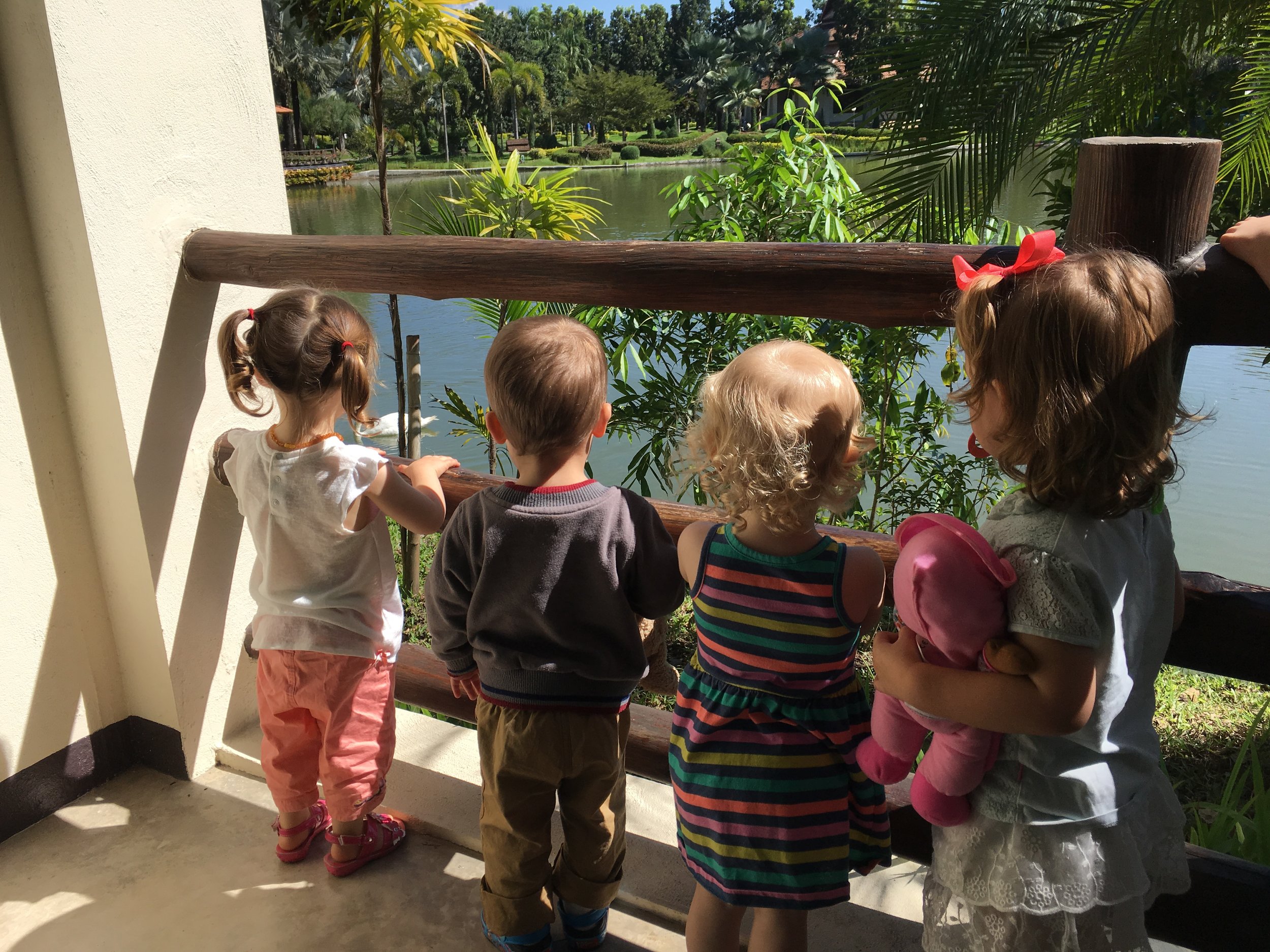
Suffice to say, I was accepted, along with my husband who led the team (which included two other area churches), to serve in Thailand, taking care of 80 third-cultural kids—ranging from babies to teenagers—as their parents attended a week-long conference that included training and much-needed rest and recreation. So, my willingness combined with the STAMP committee’s acceptance, I counted my application as God approved. Not a very spiritual measuring tool I guess, but we don’t all get burning bushes, you know. 

What can I say that would compel you to apply for one of the short-term missions trips? That it keeps you busy? That you have a skill they need and you just should go? Yes to all that, but that sounds rather sterile. There must be more compelling reasons to apply.

As it turned out, there were more compelling reasons for me as well. I did get to check off wiping noses and bottoms and consoling some pretty inconsolable (at first) babies and blowing about a thousand bubbles and singing "Father Abraham" till I hear it in my sleep two weeks later. All tasks that needed to be done; all checked off. And my deep-rooted sense of duty notwithstanding, I was blessed. Blessed beyond measure.

My mom used to come back from serving in a nursing home ministry and cry with both joy and some unrealistic guilt about getting so much out of it when she was the one who went to serve. She seemed to think serving should be hard—more of a sacrifice than plain joy. And that's my compelling reason to you. You will experience just plain joy.

You will go to serve and there will be parts that will be extremely hard, but you will be blessed. You may have to give up work days, raise support, maybe get a babysitter or a vaccine or two. You may have to buy Airborne and Zicam for the plane. But the needs are great, and I know some of you who are reading this are qualified to do the work.

You could go to Arizona to work on the roof of a radio station that broadcasts God’s love over the border. How many people might not get to hear the Word if that roof gives out? Can you help fix a roof? Or you could go and help build new school buildings for at-risk kids in Haiti, or engage Vietnamese Christians in evangelistic conversations at English language camps and cultural education excursions (in other words, talk), or build security walls and help in day camps for at-risk kids in Dominican Republic, or love on and serve through the distribution of clothes, food and the gospel to the refugees in Greece. Or, if you’re an outdoor-loving college- age student or a hiking enthusiast regardless of age who's willing to help other students practice their English language skills and open gospel doors as you hike the mountains of Romania, you qualify.

Yes, there is sacrifice. We've been back for ten days and are still resetting our internal clocks so we stop falling asleep at 8 p.m. only to wake up at 3 a.m. Someone told me that we still have about four more days before we even out. Was it worth it? It was so worth it.

If we didn’t go, topping off the child to adult ratio to exactly the numbers required by our short-term rule, missionaries with children would have had to sit out the retreat, missing out on worship, seminars and rest. And they seriously needed that rest.

I would have missed the great privilege of hearing amazing stories of triumph, hardship, heartache and perseverance to stay true to God’s calling and gospel sharing in some of the most difficult places on earth from women who are just like me—except for the fact that my life is easy. I don’t have to wear a burka. I can get any food I want, drive anywhere I want, sing Fernando Ortega songs right out loud with my windows open—any time I want.

Yet these women and I were able to sit around a table with yarn and fabric and adult coloring books (I did crafts with some of the women in the afternoons as well as baby duty) and talk about life and struggles and relationships. Aside from those hard differences, we were friends, sharing and praying and crying together like biological sisters, like true sisters in Christ. They needed that and it turned out, so did I. They were so happy to have a chance to pray, color, sew, crochet, worship, play games, get much needed counseling care and share meals with their peers. And if our team wasn't there to take care of their kids, it couldn’t have happened.

Yes, you may return a bit haggard from the trip but small price to pay for the pure joy of knowing you were able to make a difference. I am fulfilled.

Should I Stay or Should I Go by Jennifer Miller

I can give you all sorts of reasons to only give that STAMP 2017 brochure a passing glance.

The trips are for people with summers off or whose kids are out of the house or who are young and full of energy or who aren’t scraping to make ends meet or who are already connected to the missions department and know the missionaries personally.

I get all that. Last summer I said good-bye to my three- and one-year-old sons and boarded a plane for a country I had never visited to work with people who didn't share my culture or mother tongue. Even as I was sitting on the plane I wondered, “Is this the right choice? Is this the right time? I am going to wake up each day with only a faint idea of what I would be doing.” Not exactly the most encouraging way to begin a missions trip as I sort of counted the cost—both financial and personal—of my short-term missions trip.

I discovered that it was so worth it.

During the College Church trip to the Island of Lesvos, Greece, last summer, the Lord performed a priceless work in my heart. As we walked into the refugee camp for the first time, my first impression was the lack of accommodations. I knew that refugee camps weren’t fancy, but I expected people would at least have a cot to sleep on.

In truth, many did have cots, but as we first walked into the camp, the main path was littered with cardboard that people used as a layer between themselves and the harsh gravel as they slept on the ground in makeshift tents of blankets, tarps and cardboard.

As you can imagine, I came home from this trip different. God broadened my understanding for the plight of the refugee as well as the residents of the countries receiving refugees. I came back burdened to pray for the lost. Suddenly, my complaints that seemed legitimate only weeks before vanished into thankfulness.  

The Bible teaches that evil cannot triumph over God’s great redemption plans. I believed that truth for years, but last summer I saw it come to life in the faces of new believers at the camp. So how does that work itself out in a refugee camp? The more I learned the reasons that caused people to leave their countries, the more complicated, complex and bewildering a solution seemed to be. My mind searched for a way to fix the problem, but God was working through it.

One day, I sat on a bench by a gate and listened to a man who had escaped ISIS in Iraq. He recalled how he had always desired to know who God was, and it was at the camp, through conversations and friendships with some of the relief workers, he came to know God in the person of Jesus. He described his journey as a refugee as painfully awful but also a wonderful gift of the Lord drawing him to himself. I glimpsed the glory of the truth I so easily believed magnified in the face and voice of this new believer.

Now don’t get me wrong, there may be legitimate reasons not to go on a short-term missions trip this year. God does not call everyone to every trip every year. But don’t count yourself out just yet. Consider and pray if this is something God has for you. Not doing so might mean missing out on some beautiful blessings from the Lord.

To help nudge you along the way, here is where you can apply to the 2017 STAMP trips, including a return trip to this refugee camp. Application deadline is February 5.