The Boy with a Face Like Moses by Rachel Rim

If you were to ask me about the closest I’ve come to seeing God, I would tell you about Nouwi.

I would tell you about the small, dark-skinned boy in the adaptive PE class I helped with in high school—limbs scrawny, eyes mistrusting, a mouth that, in rare moments, curled upward in a private smile. I would tell you about his strange gait, as if he was testing each step further into the world to see if it could hold the weight of his private pain, and about his voice, low and nasal and almost melodic in its slow cadence. His shyness was a fortress. It was implacable. Head always ducked, hands always finding pockets, and if he didn’t happen to be wearing any, he’d use armpits and t-shirt sleeves or fold his arms across his chest to protect himself against-—something. Everything. A frightening world. The need for eternal, wearying suspicion.

I would tell you about Nouwi’s horrendous basketball skills—the way he flinched every time someone gently tossed him a ball, how he couldn’t dribble to save his life and didn’t believe in salvation anyway. But someone signed him up for Special Olympics that winter, and so I went from seeing Nouwi three times a week to four, each time trying like water to break through his impenetrable gates, wishing he played defense half as well as he lived it.

The closest I’ve ever come to seeing God was one frigid December night in a rubbery middle school gym. Teams of specially gifted kids played basketball with each other, having so much fun that the scoreboard was simply a curious afterthought. Nouwi always came and never played, choosing instead to sit cautiously on the sideline, his dark eyes narrowed against a world hell-bent on hurting him. But one night Coach called Nouwi into the game and he reluctantly joined the bodies jogging back and forth across the court, trying his best to remain a ghost. Except somehow, unbelievably, the ball ended up in Nouwi’s hands—to no one’s greater surprise than Nouwi—and suddenly he was a ghost no longer, and in his shuffling gait he ended up in front of the basket, and he pushed with all the desperation of his thin arms and thinner childhood—and the ball swished gently through the net.

For a split second, everything stopped—time, voices, the lonely trauma of being alive and human—and then sound broke like the crest of the ocean upon our heads and we were on our feet, shouting, shouting his name, and Nouwi was sprinting back toward the other end of the court with a smile splitting his face, and it was the opening of a gate, the lowering of a drawbridge, and his hands covered his face because, like Moses, surely so much joy had to be blinding. And we were, oh we were. Blinded, blinking, for all the world unable to look at him without seeing sunspots.

If God was anywhere that freezing winter night, he was in that old gymnasium in an utterly forgettable suburb of Chicago. In the laughter; in the mothers watching every move of their children; in the fathers eagerly offering arms and legs for extra practice; and in the small, dark boy streaking across the polished court with a face too radiant, eyes too bright, and we all of us blinded by something too sacred to put into words.

That night meant something for me the moment Nouwi put the ball through the hoop, and like wine it has only ripened since. I carry that memory in my pocket and take it out every so often, on nights when I struggle to find God in the Bible or in church or in my too-dark self. I wonder about God’s relevance sometimes, when you believe and are still sick and I believe and am still lonely. I wonder if maybe the only true part of Scripture is the Preacher crying, “all is vanity.”  But that night remembers me better than I remember it. That night tells me that once God was present and alive, and like the Israelites, I squint into the staggering brightness, because as much as it pierces it also promises: that God has indeed been in our midst. That his presence is light and the darkness has not overcome it. That at least one among us has met with him and lived to tell the tale, and against all odds the tale is good, so good, and so stop fearing Nouwi, let down those walls, unfold those arms… For a moment you were more real than all of us, more real than we could bear and we could not behold your face and live.

Further Up and Further In

When this life ends, you'll draw me across the void,

as my soul is set free and my sin is destroyed.

The old will melt away to be replaced with the new,

and I'll know the perfect mystery of my life, all through.

Sun, rain, and snow will all now bring peace,

as from man's curse, your earth is released.

Every mountain, wood, and stream will be perfected,

and anything less will be wholly rejected. 

As we climb further, we will long to see more

of the glorious wonders our home has in store.

Every desire and longing will from now on be sated

by the beauty and joy your loving mind created. 

Your children will be joined in an eternal choir

to praise your Son for saving us from the fire.

Each of us will be seen, inside and out,

and our minds cleansed forever from doubt.

As you draw us in, we will know and be known,

free to cast ourselves at the feet of your throne.

Finally, at last, we will enjoy eternity in your presence,

from which there will be no loss or severance. 

I will see you face to face and hear your voice like thunder,

which will be as familiar as my own, but still fill me with wonder. 

by Alyssa Carlburg

One Warm Christmas Eve

For one of our cross-cultural workers, the wonder of Christmas is that it comes even though it isn’t wrapped in childhood memories.

One warm Christmas Eve . . .

This still doesn’t make sense to my Midwest American senses. Most of my memories of Christmas Eve involve cold weather. Bundling up to go caroling and returning to drink hot chocolate and eat Christmas cookies, going to the Christmas Eve service at church, having soup and homemade bread for dinner, followed by a drive to look at all the Christmas lights on the neighboring houses. Always with family, friends, good food and music.

But here in Indonesia, we have definitely experienced the Christmases that you hear about from someone else’s exotic vacation—sunny blue skies, tropical breezes, swimming, drinking cold lemonade. We enjoy salad and ice cream on a warm Christmas day, wear flip flops and tank tops, celebrate with the local people and with new, and often, very different food.

Last Christmas – our second here – we broke down and bought a fake Christmas tree. This was tough for me since I grew up with a fresh-cut tree every Christmas, so I embraced yet another change in our celebrations. As we welcomed a new family to the field and helped them get settled right before the Christmas season, we lamented the fact that they were celebrating their first Christmas in a place that wouldn’t even be their home a few weeks later.

We discussed various changes that we would experience during the season as we were away from “home.” As we talked about missing Christmas traditions in different parts of the world, my new friend gently stopped me with a poignant question: “Isn’t Christmas really about focusing on Jesus . . . no matter what?”

Needless to say, wherever we are in the world – America, Germany, Indonesia or anyplace in between – we take joy in knowing that once again we can celebrate the birth of our Savior, Jesus Christ (as well as his life, death, resurrection and triumph over sin and death)!

Despite the company, the weather, the traditions, songs, foods or type of tree, we can still choose to celebrate the greatest gift of all: Jesus Christ! We pray this will always be our attitude for this season of Advent.

First Snow

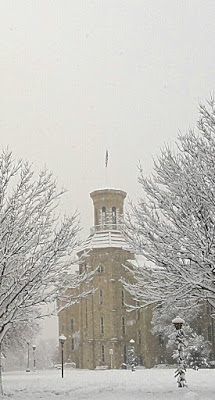
I walk across campus and am struck by the playfulness. Children everywhere, in the shape of college students. I count five snowmen and four snow structures with a quick scan of the landscape. A snowball fight emerges and I have to duck.
evergreens - 
in this cold world
another sunrise

by Dan Haase
wanderer for wonder, whimsy, & wisdom


The Sense and Nonsense of the Incarnation

Wallace Alcorn reflects on the wonder of Incarnation

If I were to write a sequel to C.S. Lewis’ Screwtape Letters, I would instruct Wormwood to attack first the doctrine of the deity of Jesus Christ—especially the Incarnation, by which God became man. If you can convince people either that Jesus was not God but just another human or, alternatively, that God did not become man in Jesus but remains totally different, you will have broken the only possible connection between God and humans. Everything else about Christianity will fall apart with this disjunction. You won’t even need to dispute the existence of God, because without the Christ of God the existence of God wouldn’t make any difference. You will have won everything, and the game is over.

Be advised, Wormwood, do not attempt to dispute the historicity of Jesus of Nazareth. This is just too well documented, and it’s not really necessary. All you need do is convince people that Jesus was only a man. You can even afford to praise Jesus as a very good man—the greatest man who ever lived, for that matter. In point of fact, this is the smart thing to do. People are quite willing to admit Jesus actually lived and was a very good man. This is no threat to our cause. The really crucial thing is that you convince people Jesus was not God.

Now, I talk no longer as a Screwtape but from my own sense of awe at what God has accomplished. To be boldly honest, the incarnation is utter and absolute nonsense. It is contradicted by nothing less than the basic laws of thought, exhaustively discussed by philosophers and taken for granted by us all. Without compliance with these, there is no thought and language has no meaning. The law of identity has it that a thing is itself and nothing else (in the same way and at the same time). On the other end is the law of contradiction: A thing is not both itself and not itself (in the same way and at the same time).

The law of identity puts it, then, that Jesus can be man and God can be God, but Jesus cannot be God and God cannot be man, because each would be something other than what is. To say this is so is nonsense. Likewise, the law of contradiction puts it that Jesus cannot be non-Jesus, e.g., God. God cannot be non-God, e.g., man. In this respect also, it is nonsense.

Logically nonsense and ontologically impossible that the incarnation is, the incarnation, well, is. Jesus Christ is, in fact, the God-man. That human thought has no category to accommodate it and that human language has no term adequate to express it is all beside the point.

The point is precisely that God who created everything created the incarnation and its God-man. Moreover, God reveals as much in what has been demonstrated to be the divine Word of God. Finally, Jesus Christ himself demonstrated his God-manness by the perfect life he lived and what he has accomplished by his death. He has resurrected from the death of sin those who have become alive in Christ.

This is to say that the impossible not only has become possible but actual.

Because the incarnation makes no sense in finite, human thought and language, any effort to explain this beyond this little is bound for failure. All well meaning theologians have ever been able to do through the centuries is to focus disproportionately on one aspect of the God-man (usually because it hasn’t received adequate consideration) and all other aspects, equally valid as they are, fall apart as being contradicted by the distortion.

No one has yet been able to articulate a logical explanation of this illogical reality. Not to worry: It is our opportunity in salvation to experience what it means for Jesus Christ to be the God-man who is both our Savior and Lord. We can experience what we cannot explain or even understand.

Come, Let us Reason Together by Trisha Williams

Some of you may be familiar with the Holderness family’s latest YouTube parody video “Welcome to my Couch.”  It begins with a family and neighbors gathered around a table loaded with traditional Thanksgiving fare. Dinner conversation begins well enough, but quickly derails into political commentary and bickering that gets physical and ruins the meal.  To restore peace, the football game is turned on and the angry guests are plied with so much alcohol that they become best of friends. At the end of the video, clips of children hugging it out and animals at peace with each other are played. Refrains of “Let’s all be friends now” and “Let’s love each other” are heard. Penn, the father and narrator asks the question: “If dogs and cats can get along, then we should be able to get along at least for one day, right?” 

Funny? Yes. Quite possibly prophetic reality for many this week? Perhaps. 

Surely there must be a better way to deal with our conflicts than the “bandage” of alcohol, entertainment and photo montage of cute children and puppies? Surely Christian unity depends on something other than a fake it till you make it mentality? The election results have been most revealing and troubling, particularly when the so-called Christian vote is considered. Clearly, the church in America is seriously divided, and I’m sure we’ve all noticed how vitriolic that divide is becoming on social media and in the news. It’s heartbreaking really. Anyone who loves Jesus should also love their spiritual brothers and sisters, and so this divide feels like the pain of a divorce in many ways. A family is being torn asunder, and how is the watching world supposed to know us for our love when we’re all too busy tearing each other apart? 

It was at another table for a different celebration when Jesus gave his disciples these instructions:

A new commandment I give to you, that you love one another: just as I have loved you, you also are to love one another. By this all people will know that you are my disciples,
if you have love for one another.

We can all read. We all see these instructions, but sometimes I wonder if we think that the love Jesus refers to is no different than the love that Penn Holderness spoke of in his parody video. A “love” that can keep the peace for one day, and then turns into backstabbing each other the rest of the year. I recognize, because of my own sin, that actual obedience to Christ’s commands is not easy. Things get really confusing when our pride, politics, possessions and passion for our version of the truth come into play. 

Before giving his disciples these words, Jesus revealed that Judas would betray him and he had already left the table and the room. Hadn’t the group’s unity already been disrupted?  Despite Jesus warning his disciples of his upcoming death, they didn’t fully understand, and when his arrest and crucifixion came, many scattered in fear and doubt. It took them years of faithful practice to actually live out Jesus’ words, and in their practiced obedience, we have accounts of their failures as well. And yet the command still stands. So how do we obey it?

The Old Testament presents an interesting account in the Book of Joshua that gives some timeless principles to help us figure out what biblical love for our spiritual family actually looks like when disagreements arise. Joshua has obeyed all that the Lord asked him to do in taking possession of the Promised Land and distributing the land among the tribes of Israel. The first tribes to get their land under Moses were the Reubenites, Gadites and the half-tribe of Manasseh on the eastern shore of the Jordan River. The fighting men of those tribes then cross the Jordan River to help possess the land for their brethren. After seven years of fighting, Joshua releases the men to return to their land with many thanks, material rewards and words of warning. They are to be careful “to love the Lord your God, and to walk in all his ways and to keep his commandments and to cling to him and to serve him with all your heart and with all your soul.”

Before crossing back over the Jordan River on their way home, these tribes, oddly and seemingly somewhat randomly, decide to build “an altar of imposing size.”   

When all the rest of Israel heard of it, “the people of Israel gathered at Shiloh to make war against them.” I read this and think, Wow! Major overreaction! How and why did they so quickly go from thanking their brothers to being prepared to kill them? 

The answer comes when Israel decides to send a delegation of wise men led by Phinehas to try to reason with these tribes before sending the army to kill them. The majority tribes had jumped to an immediate conclusion about their brethren that proved false upon closer examination. The western tribes viewed the “altar of imposing size” and assumed that the eastern tribes were breaking God’s commandment and engaging in idolatry. Their righteous zeal drove them to fear divine judgment, and for everyone’s sake, they were willing to even kill their idolatrous brothers to spare the rest of Israel from God’s judgment. 

It becomes clear that the eastern tribes had intentionally built the altar to provoke and garner attention, but in no way were engaging in idolatry. This was not an altar to be used for worship purposes, but an altar to stand as a reminder for all of Israel and their descendants that no geographical divide like the River Jordan, or even no tribal and family loyalty, would separate the bond all the peoples of Israel shared. Their unity was because of and found in the “The Mighty One, God, the Lord!” 

The altar of imposing size is called Witness, “For it is a witness between us that the Lord is God.” The western tribal delegation returns to Shiloh, “and the people of Israel blessed God and spoke no more of making war against them.”

Such a fascinating story! Here are some observations that might be relevant to our situation today as we deal with a divided church. 

1. All of Israel cared for God’s holiness and were righteously zealous on his behalf. At least at this point they understood that sin had far-reaching consequences. One person’s sin could destroy them all. They weren’t taking any chances. 

2. Their zeal caused them to make a false assumption, but they were wise enough to use reason first before declaring war. Wise leaders show restraint but also take sin so seriously that action is taken. Wise words and listening ears will always be stronger than any sword.

3. The eastern tribes were also wise. They knew that humans put up barriers and are prone to forgetfulness. We need constant reminders of whose we are and who we are supposed to worship in order to maintain proper fellowship. We can’t let geography, tradition, skin color, grudges, personal preferences, tribal (read denominational) and political differences divide true brothers. The source of our unity transcends our human preferences and natural loyalties.

4. We must be willing to help each other to the point of great sacrifice. When the western tribes feared the eastern tribes had fallen into idolatry because of where they lived, they offered to make space for them in their own land. This type of generosity is wonderful, but it would have been so costly. But they were willing to do it!  Our sin is a matter of life and death.  Our temporal reality is just that, temporal. We all face eternity and what God cares about should be our top priority. 

5. Worship of God demands obedience to his commands. Out of proper worship comes proper love for each other, and then proper unity will follow. 

“Come now, let us reason together, says the LORD: though your sins are like scarlet, they shall be as white as snow; though they are red like crimson, they shall become like wool.”

Our altar or “Witness” that unites disciples of Christ together around the world is the Table of the Lord’s Supper. We all gather around it on a regular basis and remember Christ’s body and blood shed for us. True Christians have been washed clean by his blood, and therefore, we can indeed reason together around this most holy of all tables. 

Blessed are those who are invited to the marriage supper of the Lamb. One day the church will rejoice to be seated in perfect unity and fellowship around the Table of the Lamb. Until that day, let us try to love each other as Jesus commanded us, knowing we will stumble and sometimes fail, even perhaps as we gather together with friends and family this Thanksgiving. But let us still try! It’s an effort worth everything.    

Hallelujah!

For the Lord our God

the Almighty reigns.

Let us rejoice and exult

and give him the glory,

for the marriage of the Lamb has come,

and his Bride has made herself ready;

 it was granted her to clothe herself

with fine linen, bright and pure—

for the fine linen is the righteous deeds of the saints.