Have You Ever Looked at Water

by Vikki Willams

A:

Have you ever looked at water?

Have you ever looked at glass?

Have you wondered if you ought to

stand and wait the storm to pass?

B:

Have you seen a faded red rose?

Have you seen when summer’s passed?

Have you wondered at the day’s close

Why the time should even last?

C:

Have you ever felt the ice-wind?

Have you ever felt the fire?

Have you ever had your arm pinned

‘Twixt the blizzard and the pyre?

D:

Have you laughed among the happy?

Have you laughed among the lost?

Have you felt the current lapping

'Round your ankles for the cost?

E:

Have you ever cursed the sunshine?

Have you screamed into the rain?

Have you crossed a bloody fault-line

just to staunch a spreading stain?

F:

Have you learned an invocation?

Have you learned to read some Psalms?

Have you pled for our salvation

Holding outstretched, empty palms?

F’:

You have known the disappointment.

You have known the state of shock.

Can you keep your next appointment

If you cannot use the clock?

E’:

Have you tasted of the honey?

Have you eaten of the pods?

Have your hunger and your thirsting

Brought you back from other gods?

D’:

Have you wept among the lonely?

Have you wept among the weak?

Have you wandered looking only

For the blessing that you seek?

C':

Have you ever felt the wind's tail?

Have you felt the winter's snows?

Have you ever seen a child fail,

and then wonder how it grows?

B':

Have you ever watched the sun rise?

Have you watched it as it set?

Have you wondered when the lark cries

Why your need to rest is met?

A':

Have you looked upon the ocean?

Have you looked upon the shore?

Let us journey up the mountain

Though our feet be scarred and sore.

A note from Vikki: "Have you ever looked at water?" is an intense poem about beauty, loss, the yearning for redemption, and the not-so-easy path to capture it. All this is fitted into a roughly chiastic structure. (That is, when verses are in the sequence A, B, C, C', B', A', the verses A and A', etc. form a pair.)

Hope

by Liita Forsyth

This isn't the first time artist Liita Forsyth has shared her work with College Church. She and her husband, Paul, were members here before they moved to River Forest, where they now attend Calvary Memorial Church in neighboring Oak Park. OneWord Journal is pleased to feature Liita's art once again.

Says Liita, "The idea in this piece is HOPE, which the psalms are full of . . ."

Dysl3xia

A Song of Lament by Nancy Tally

Oh Lord, you knit me together but did you have to drop 

so many stitches when you made my brain?

You must have dropped stitches for there are so many holes

 into which my words and thoughts fall and disappear.

I must admit, you were creative about it.

The variety seems endless.

The letters in one word may dance about

 making them impossible to erad or pesak.

Letters from multiple words may mix together

Causing a cacophony of Sorgi ts hunod.

My eyes may read them out of order.

“Is it so?” Or was it, “It is so.”

My ears may hear them out of order

“We are marching into the enemy’s camp” made no sense.

Oh! All those years it was actually “Are we marching?” 

As I listen words may chute through holes and not reach my brain

 in the same order in which they were spoken.

My face echoes my confusion as “Huh?” escapes my mouth.

The roll of the eyes on the speaker’s face says “Duh”

I stand in a group wanting to enter the conversation,

My thoughts are together,

As I open my mouth key words fly away.

Friends may offer me words as I struggle, I still appear stupid.

I am embarrassed and swear to myself I won’t speak again.

Why does my tongue trip and say my words out of order?

Why does it change my chosen word to something similar but wrong?

In print an editor may catch the confusion that I cannot see.

In writing I have time to make corrections that conversation does not afford.

The praise is received. People like what I wrote. 

But my fear is confirmed.

As they express their surprise that I can think deeply,

I know it is true, people perceive me as shallow.

Lord, maybe you didn’t drop stitches.

Maybe moths put holes there after you were done.

Refugees in Real Time

We hold our refugee simulation events. A short-term team goes and returns from the much-reported refugee Camp Moriah on the island of Lesvos in Greece. Team members are profoundly moved and motivated to pray and do more for refugees. They come back and touch our hearts with their experience. But none of us live in a camp. We can go home again. 

As we are in the midst of our "Refuge" missions festival, let's consider how God is at work in Camp Moriah. College Church missionaries Thad and Joy McAuley and Tim and Deanna Smith recently sent in updates about the refugee situation.

The McAuley family has been back in France for about two months now, and Thad describes the scene in France and Europe.

"A lot of police and military personnel in public places—schools, events, monuments, airports and train stations. Foiled bomb plots of young women. Knife attacks against police. Riots in refugee detention camps . . ."

Yeah, we've read that. Watched that on the news.

But then Thad goes a step further, beyond the news reports, "Muslim refugees coming to Christ, and then leading others to Christ. Discipleship groups starting. European churches re-energized as they respond to the needs around them."

A team, working at Camp Moriah, sent Thad this report last week.

Spiritually, people are incredibly open. All of our people are having significant conversations and were even before the riots. A random Somali guy stopped one of our guys on Sunday to talk about faith. Another had a 90-minute conversation with someone else his first day in [the refugee camp]. Naser, one of the translators injured [in the riots], had accepted Christ earlier in the day. It reminds us of the early days in Eastern Europe when incredible numbers of people came to Christ.

Tim and Deanna' Smith's recent report describe the riots and its impact on the camp.

"In September, the population of refugees had swelled to more than 5600 people in a camp designed for 3500. A peaceful protest against the crowded conditions had escalated into ethnic violence. Panic stricken, thousands of people fled the camp as fires burned uncontrollably. In the aftermath of the riot, Arnie declared, 'The fish are jumping in the boat.'"

"Arnie and his team are integrally involved in helping the refugees in Moria this year. Their most immediate task was to evacuate the unaccompanied minors to an olive grove. A team of six adults were responsible for 150 teenagers. They were able to move them to a children’s camp several hours later. Remarkably, there were no deaths. Arnie took three refugee translators who had been injured to the hospital, and the whole team returned to the camp to help clean up and set up new tents."

Tim and Deanna end their report with this: "People who have lost everything are meeting Jesus in record numbers."

Good words for followers of Jesus to take to heart, especially amidst all of the chatter and political perspectives on the refugee crisis.

People who have lost everything are meeting Jesus and finding refuge, a new home, in him.

A Life of Its Own

Every once in a while, a Saturday Musing takes on a life of its own. That's what happened with the musing about Joe Bayly--College Church attender, husband, father, author, publisher, child of the heavenly Father. No sooner had the musing gone out, than emails came in from people who knew Joe only through his writings as well as those who knew him face-to-face.

Here are some of the emails that came in. At the end, we've posted "A Psalm of Wandering" from Joe's book, Psalms of My Life, used by permission of his son Tim, who recently wrote his own book on fathering. (The College Church Library has books by Joe and many are available online.)

  • "A remarkable gentleman--gracious, good humor and lots of insight."
  • "Some of the comments in his book A View from the Hearse [now titled, The Last Thing We Talk About] have stayed with me through all the losses I have had in life. I only knew them to say hello, but they left me with wonderful tools."
  • "I remember Joe and Mary Lou so well. I read Winter's Flight and it had a very humble impact on my life. I remember them with fun, humility and I honor them for their Christlike lives."
  • "I agree with your description of Joe's welcome of varied thoughts in discussions. He often shared the teaching of a large Sunday school class back in the day."
  • "The Bayly family was one of the major reasons I loved the church so much. I left Wheaton College for one  year and spent it at Kansas University because Joe encouraged me to go to a place where I would be uncomfortable."
  • "I will have to share this with my father-in-law. Joe was the best man at his wedding." (This was from Dawn Clark, by the way.)
  • "I never met him even though I lived in Wheaton in his time. I bought his book Psalms of My Life. I love it and the beautiful calligraphy by  Tim Botts.
  • "I wanted to know that someone like this existed . . . and even was a part of our church's recent history."

A Psalm of Wandering
by Joe Bayly

Lord You know

I'm such a stupid sheep.

I worry

about all sorts of things

whether I'll find grazing land

still cool water

a fold at night

in which I can feel safe.

I don't.

I only find troubles

want

loss.

I turn aside from You

to plan my rebel way.

I go astray.

I follow other shepherds

even other stupid sheep.

Then when I end up

on some dark mountain

cliffs before

wild animals behind

I start to bleat

Shepherd Shepherd

find me save me

or I die.

And You do.

Psalm of Lament in Three Parts

1. After working a long shift, Mom came home

To fix supper. Bring me another beer,

Dad said. So I did while Mom cooked.

She filled our plates as I got my own glass of milk.

Mom brought dinner hot from the stove

And set Dad’s down on the coffee table in front of the tv

So we could watch Wheel of Fortune together.

He looked down at the plate of food she’d fixed,

Then flung it across the room in disgust.

He never liked vegetables to touch meat.

I threw my glass of milk in his face

Which shocked us all in different ways.

Father, forgive.

2. When they used to call me Saul, or something like that,

I knew truth in my own familiar way.

Going off to camp wasn’t what it is here.

Not at all. And yet, oddly similar…

Weapons, devotions, survival skills, prayers.

And as I went deeper into this way of truth

I found a certain pride in what most others feared.

Looking back, it surprises me still

How simple and right it seemed

To take a life; and then, lives.

The cracks and gurgles and groans of death,

Though, gave way to a sort of silence.

And then, the Dream came. Father, forgive.

3. You know, the guard said to me,

If they set you free, who will be left

To tell me the things you do.

I know no other soul whose eyes have what your eyes hold.

Once I even heard you sing

And even though I could not comprehend

the words or tune, I wanted to.

If they release you, I’m afraid

That I’ll be bound to life without you

Or the God you love,

The One who brought you here to me.

Me—whose job it is to keep an eye on everything you do.

Even though I don’t believe,

When you talk to that God of yours,

I think that you and he are talking about me.

And tonight, I'll lock you up, put the keys away,

And as I walk away, hear you say, like you always do,

Father, forgive.

by Wil Triggs

Gone Visiting

In September, cross-cultural worker Katherine came back to the States to celebrate her brother's wedding, totally unaware that she would end up staying to attend her mother's funeral, who died unexpectedly while Katherine was home. Though her grief was fresh, Katherine returned to her work and asked her teammates if she could tag along as they paid visits to friends and their families in refugee camps. In Katherine's words, "God gave us good times, and I thought I'd share two story snapshots."

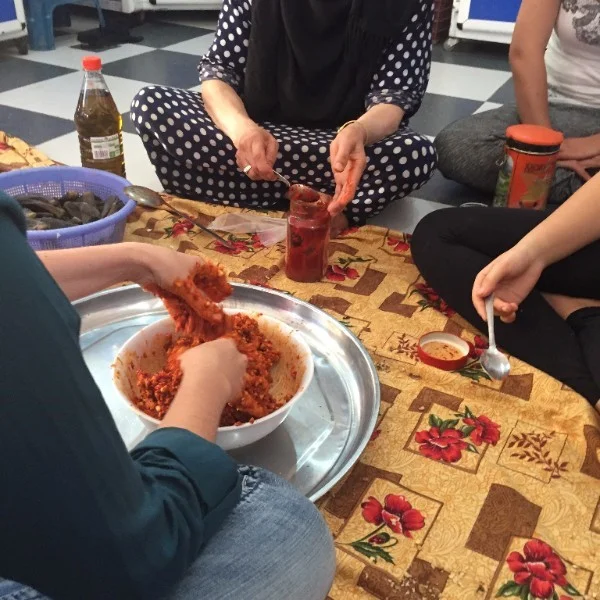
Fall Pickles and Baby Eggplants
Katherine recalls one visit, where she and her teammates joined the women in the kitchen, "the matriarch, her daughter, a few daughters-in-law and granddaughters were all there. Together, we finished making the last of the fall pickles as well as baby eggplants stuffed with walnuts, red peppers and garlic. As we worked, the matriarch told us, 'Last year, I didn't do any canning or make any pickles. I thought we would go back to Syria and have to leave everything here. This year, my kids, everyone insisted that I make them.'"

This matriarch and her fellow Syrians are, as Katherine describes, "weighing how much to commit to their new lives. Should they plan to go back or would it be better to settle here? Keep praying that families here would find both work and education for their children, a fair wage for their work and to be able to live in greater peace and security."

A Near Miss
A few days later, both Katherine and her teammate were exhausted and thought about postponing their visits that day, but then went ahead anyway. Relates Katherine, "When we arrived, we found that the couple who had invited us, also invited some of their neighbors and relatives—all waiting for us. And they were waiting to read with us and were upset that we hadn't come sooner." 

The wife, Shahida, and her husband and the others who were there read the Creation story. They were amazed at how much they understood and at how much they discovered about who God is. "We asked how they wanted to apply or obey the passage they just read," Katherine says, "and they all wanted to read more. Shahida said she wanted to tell others what she had learned. God's Word spoke so clearly to them."

Katherine and her teammate left their house in the camp, dumbstruck at how they almost missed this joyful visit, but looked forward to the next study. "Please pray for Shahida, her husband and everyone who was there," encourages Katherine. "Pray that their hunger for the Word would grow and that they would become disciples."