A Life of Its Own

Every once in a while, a Saturday Musing takes on a life of its own. That's what happened with the musing about Joe Bayly--College Church attender, husband, father, author, publisher, child of the heavenly Father. No sooner had the musing gone out, than emails came in from people who knew Joe only through his writings as well as those who knew him face-to-face.

Here are some of the emails that came in. At the end, we've posted "A Psalm of Wandering" from Joe's book, Psalms of My Life, used by permission of his son Tim, who recently wrote his own book on fathering. (The College Church Library has books by Joe and many are available online.)

  • "A remarkable gentleman--gracious, good humor and lots of insight."
  • "Some of the comments in his book A View from the Hearse [now titled, The Last Thing We Talk About] have stayed with me through all the losses I have had in life. I only knew them to say hello, but they left me with wonderful tools."
  • "I remember Joe and Mary Lou so well. I read Winter's Flight and it had a very humble impact on my life. I remember them with fun, humility and I honor them for their Christlike lives."
  • "I agree with your description of Joe's welcome of varied thoughts in discussions. He often shared the teaching of a large Sunday school class back in the day."
  • "The Bayly family was one of the major reasons I loved the church so much. I left Wheaton College for one  year and spent it at Kansas University because Joe encouraged me to go to a place where I would be uncomfortable."
  • "I will have to share this with my father-in-law. Joe was the best man at his wedding." (This was from Dawn Clark, by the way.)
  • "I never met him even though I lived in Wheaton in his time. I bought his book Psalms of My Life. I love it and the beautiful calligraphy by  Tim Botts.
  • "I wanted to know that someone like this existed . . . and even was a part of our church's recent history."

A Psalm of Wandering
by Joe Bayly

Lord You know

I'm such a stupid sheep.

I worry

about all sorts of things

whether I'll find grazing land

still cool water

a fold at night

in which I can feel safe.

I don't.

I only find troubles

want

loss.

I turn aside from You

to plan my rebel way.

I go astray.

I follow other shepherds

even other stupid sheep.

Then when I end up

on some dark mountain

cliffs before

wild animals behind

I start to bleat

Shepherd Shepherd

find me save me

or I die.

And You do.

Psalm of Lament in Three Parts

1. After working a long shift, Mom came home

To fix supper. Bring me another beer,

Dad said. So I did while Mom cooked.

She filled our plates as I got my own glass of milk.

Mom brought dinner hot from the stove

And set Dad’s down on the coffee table in front of the tv

So we could watch Wheel of Fortune together.

He looked down at the plate of food she’d fixed,

Then flung it across the room in disgust.

He never liked vegetables to touch meat.

I threw my glass of milk in his face

Which shocked us all in different ways.

Father, forgive.

2. When they used to call me Saul, or something like that,

I knew truth in my own familiar way.

Going off to camp wasn’t what it is here.

Not at all. And yet, oddly similar…

Weapons, devotions, survival skills, prayers.

And as I went deeper into this way of truth

I found a certain pride in what most others feared.

Looking back, it surprises me still

How simple and right it seemed

To take a life; and then, lives.

The cracks and gurgles and groans of death,

Though, gave way to a sort of silence.

And then, the Dream came. Father, forgive.

3. You know, the guard said to me,

If they set you free, who will be left

To tell me the things you do.

I know no other soul whose eyes have what your eyes hold.

Once I even heard you sing

And even though I could not comprehend

the words or tune, I wanted to.

If they release you, I’m afraid

That I’ll be bound to life without you

Or the God you love,

The One who brought you here to me.

Me—whose job it is to keep an eye on everything you do.

Even though I don’t believe,

When you talk to that God of yours,

I think that you and he are talking about me.

And tonight, I'll lock you up, put the keys away,

And as I walk away, hear you say, like you always do,

Father, forgive.

by Wil Triggs

Gone Visiting

In September, cross-cultural worker Katherine came back to the States to celebrate her brother's wedding, totally unaware that she would end up staying to attend her mother's funeral, who died unexpectedly while Katherine was home. Though her grief was fresh, Katherine returned to her work and asked her teammates if she could tag along as they paid visits to friends and their families in refugee camps. In Katherine's words, "God gave us good times, and I thought I'd share two story snapshots."

Fall Pickles and Baby Eggplants
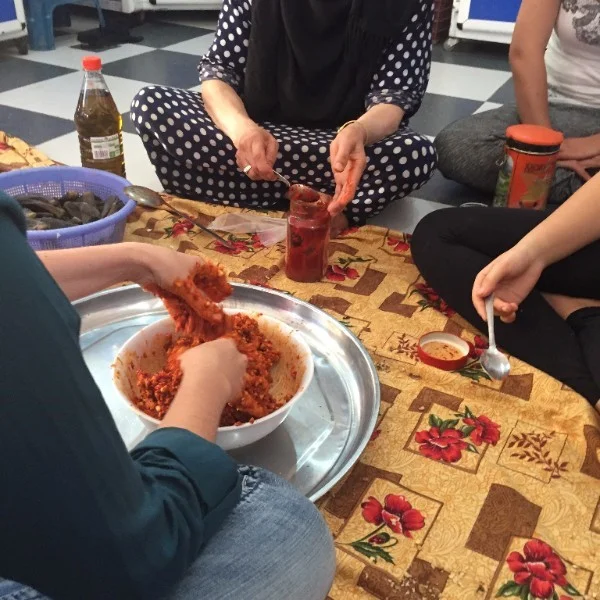
Katherine recalls one visit, where she and her teammates joined the women in the kitchen, "the matriarch, her daughter, a few daughters-in-law and granddaughters were all there. Together, we finished making the last of the fall pickles as well as baby eggplants stuffed with walnuts, red peppers and garlic. As we worked, the matriarch told us, 'Last year, I didn't do any canning or make any pickles. I thought we would go back to Syria and have to leave everything here. This year, my kids, everyone insisted that I make them.'"

This matriarch and her fellow Syrians are, as Katherine describes, "weighing how much to commit to their new lives. Should they plan to go back or would it be better to settle here? Keep praying that families here would find both work and education for their children, a fair wage for their work and to be able to live in greater peace and security."

A Near Miss
A few days later, both Katherine and her teammate were exhausted and thought about postponing their visits that day, but then went ahead anyway. Relates Katherine, "When we arrived, we found that the couple who had invited us, also invited some of their neighbors and relatives—all waiting for us. And they were waiting to read with us and were upset that we hadn't come sooner." 

The wife, Shahida, and her husband and the others who were there read the Creation story. They were amazed at how much they understood and at how much they discovered about who God is. "We asked how they wanted to apply or obey the passage they just read," Katherine says, "and they all wanted to read more. Shahida said she wanted to tell others what she had learned. God's Word spoke so clearly to them."

Katherine and her teammate left their house in the camp, dumbstruck at how they almost missed this joyful visit, but looked forward to the next study. "Please pray for Shahida, her husband and everyone who was there," encourages Katherine. "Pray that their hunger for the Word would grow and that they would become disciples."

Beloved Combo

By Lois Krogh

This last August, within two weeks of each other, the two pastors who officiated at our
wedding thirty-five years ago died and met the Chief Shepherd face to face. I am sure they
heard, “Well done, good and faithful servants.”

Both men energetically loved the Lord, his Word, his church and the lost outside the
church. They were men full of faith who cared personally about everyone they met. Both
pushed themselves to follow hard after Christ.

But, oh, how they were different! After our wedding ceremony, a friend from work asked
me where I found the “Mutt and Jeff combo” to officiate the wedding.

First, their physical appearances were strikingly different. One short and genteel; one tall and stocky. One with hair well-groomed. The other with an ever present buzz—probably self-administered. Their personalities were also different. One had a sharp mind and wit and was well-mannered. The other was intense, direct and unceremonious.

One loved skiing. The other basketball and mountain climbing. One preferred nice resorts. The other a campsite. One drove new cars, fast! The other drove a beat-up Volkswagen van and always at five miles below the speed limit.

Both were used by God to lay a foundation for my faith. Both took that role seriously.
From both, I learned to honor the Word of God, to study it systematically and apply it to my life and culture. From both I learned to serve God wholeheartedly. In hindsight I can see that the flaws of both men were also part of what God is using to mature my faith.

I am thankful God loves his church so much that he gives each local church a pastor.
They may be different in upbringing, education and experiences. They may be different in
personalities and skills. But they all serve the Chief Shepherd by teaching and loving and
leading his sheep.

There is something full-circle about Lois' musing. On October 16, she and her husband, Steve, will be comissioned as College Church missionaries with Training Leaders International,  training and equipping local pastors worldwide.

What Do You Hold in Your Hands?

by Nancy Tally with Vikki Williams

For several years, we walked through bright, golden autumn mornings together. Our routine was set: We would pile the twins into the red wagon, one twin so strong and robust that she would support her weaker sibling by wrapping her arms about her sister’s chest. Their eldest brother would pull the wagon while the other brother pushed from behind. Our procession would clatter over the quiet sidewalks, sunlight pouring down on us through a lacework of leaves.

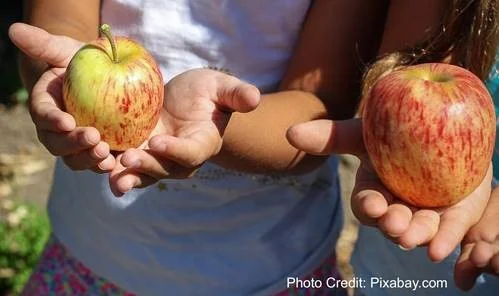
Our destination--the yard of an elderly neighbor, where a harvest of apples awaited us. There were far too many for her to deal with, but by the time we were done, her yard would be apple-free. The good apples went in the wagon, and the bad ones in the trash can. Even little children know the good apple from the bad apple. You would know right away, too, if you smelled one of the bad ones. You'd know if you saw an apple with spots so soft that a finger could squish right into, not to mention the worms wiggling their little heads out of their very round holes.

When we got home, we’d process the apples. I would make some of them into pies and freeze others. All afternoon the apple aroma would fill our house and our souls. The best part came when we would have supper. Sometimes we’d pretend we had gone to visit Heidi at her grandfather’s chalet. We would gorge ourselves on apple slices with cheese, crackers and milk. A bulk-purchased barrel of crunchy cheese balls was a regular staple in our house. We would start eating those bits of fluff and pretty soon we would be competing, throwing them high in the air to see who could catch the most in a row without a miss. In later years, the game expanded to include throwing cheese balls across the table to the kids and having them catch them in their mouths. There was tons of laughter and never a clear winner.

I still love to see and smell the apples as flood the produce section every fall. It takes me back to these good memories from when I was still nurturing those living (human) plants God had given to me to harvest. My prayer for my children was always that they would come out of my home spiritually healthy so God could use them. I did not want them so messed up that it would take years of God working on them before they could function for his glory. The results have been mixed--both with regards to the amount of time before they were ready to do what God wills, and with regards to their apparent effectiveness.

The eldest brother still leads the way, not only in teaching his own three to love the Lord, but in leading his church in worship each week. The second brother always had to find out where the boundaries were for himself. While he spent years trying to push the wagon of his life, he eventually found out he could not steer very well from that position. Now he is pulling his family together from a leading position. The strong and robust twin is still supporting others from her role as an Air Force instructor. Wondering about the weaker twin? She keeps drawing the best out of people, giving those around her a chance to give to Jesus. How? Well, for "whatever you have done to the least of these my brothers, you have done it unto me.”

A Last Minute Post Script

Two days ago I thought I was done writing this entry. Then, I listened to Pastor Moody’s sermon, "Fullness of Riches," and was struck by verses 7, 11 and 12 in Romans 11. Was I really reading that God had hardened the hearts of the religious rulers of Jesus’ day? That God himself caused their inability to see and understand who Jesus was? That he did it because his plan called for his Son to be our sacrifice and as there had to be a Judas, there had to be hardhearted rulers to bring about the Crucifixion?

Romans 11:11-12 reads, "So I ask, did they stumble in order that they might fall? By no means! Rather through their trespass salvation has come to the Gentiles, so as to make Israel jealous. Now if their trespass means riches for the world, and if their failure means riches for the Gentiles, how much more will their full inclusion mean!"

For the first time the verses started to make sense. Seeing part of the plan behind it all made my heart leap with hope as I read the last phrase: "how much more will their full inclusion mean!" Do I understand it? No, not intellectually, but it resonates so strongly with my spirit. Inclusion may not be something most people think about often. As a mom of a handicapped daughter, lack of inclusion is something I live with every day.

I am constantly aware of it. I long for my daughter to be included. I long to be included into the lives of those surrounding me in the church, but I stand there, silent, not knowing what to say. I do not possess my husband’s easy way, his gift for gab or his memory that allows him to follow up on things others have previously told him. All those those traits that tell another person that you care about them. So I stand off to the side and know what it is like to be jealous for inclusion.

Although Romans 11:12 spoke about the value of the inclusion of Israel, it stirred up other, half-formed thoughts about the value of souls. Those thoughts followed me through my day. Soon I sat down to check this post for revisions. Suddenly, those half-formed thoughts leaped on me and pried the scales from my eyes. Shame on me!

I recalled all those years, I would cringe when I had to fill out a form that asked, "What can Becca do?" I never knew how to answer it! Like so many others, I did not see her value. I could not see that she had, and has, a real ministry and work God has prepared for her to do. Becca confesses that Jesus is Lord, and years ago sought out baptism to make her decision public, it would logically follow that God has prepared good works for her to do. When I wrote, "She keeps drawing the best out of people, giving those around her a chance to give to Jesus”" I only saw how others who interacted with her were given a chance to minister.

Today, however, I realized that harvesting fruit is the work and ministry prepared for Becca. Not only does her presence in a room allow us to give back to Jesus as we interact with her, but it allows Becca to harvest. She harvests some marvelous fruit: love, joy, sometimes peace, definitely patience, kindness, goodness, faithfulness, gentleness and self-control from those around her. Her presence is like sprinkling the fertilizer that causes us to produce more fruit. Finally understanding that God has included Becca in the work that he has prepared for us to do is worth more than all the inclusion programs in this world. Pain from her lack of inclusion based on her earthly limitations dims as I realize God includes her in his plans for his people’s growth every day.

We, here, at College Church are blessed. We have 60 people like Becca, many of whom know the Lord personally, all of whom can be harvesters, the catalysts for our growth into spiritual maturity and Christ-likeness. And if they are not enough, we can look around at the bumper crop of children born in this church every year.

So on the days when our blessings have us ready to pull out our hair or just sit and cry, let's view those precious people through a new frame. A frame that reminds us that not only has God put them here for us to help them mature into the knowledge of salvation but also that they have a ministry to harvest fruit in us, to help perfect us. Perhaps today their job is harvesting patience or endurance as we learn to rely on God’s grace.

Our blessings are masters at improving and strengthening our self-control and patient endurance. Those qualities which seem to bridge a life of moral excellence and a life of godliness and love. (Check out 2 Peter 1:5-8.)

Keep bearing fruit that even the least of these can harvest, that benefits their daily lives, and acknowledges that though they may be weak or tiny, they are fellow harvesters.

Bounty of Brothers and Sisters

By Vikki Williams

For those whom he foreknew he also predestined to be conformed to the image of his Son, in order that He might be the firstborn among many brothers. (Romans 8:29)

"She came out of the womb looking for people. And not just mom! She had to locate dad in the room and siblings!” The mother laughed as she recalled her daughter's birth, adding that it was still true to this day when her now teenage daughter among friends.  As I listened to the story, I thought, “That sounds like someone even more extroverted than I!”

I can imagine a tiny newborn baby girl craning her head around to see all the people in the room, and II think, “Just like me.” You see, I am crazy about my brothers and sisters--my brothers and sisters in Christ. Some Sundays, I crane my head around to see who is sitting in the other pews and the balconies. And I think, “Wow, a lot of these people are Christians. Why should I be allowed to have so many brothers and sisters?” So many.

And then there are more brothers and sisters from tribes and tongues and nations. So many.

Sometimes I laugh to myself that God decided to save so many people just so I can have soooo many brothers and sisters. But of course, that’s not true. First, they are for Jesus Christ. Yet if believers “give themselves first to the Lord and then by the will of God to us,” (2 Corinthians 8:5), we gain an even greater portion of these friends' hearts than otherwise possible.

And not only does he give me a larger portion of the hearts of Christians I know, but also the many, many souls “who have loved his appearing” (2 Timothy 4:8) whom I will not meet before that Day, and as a great throng we will worship God together, unhindered, endlessly. 

I crave the harmony and affection of those many brothers and sisters in that Day.

This is the harvest I yearn for.

Light Side of a Dark Narrative

by Lindsay Callaway

Most of us would agree that the narrative we envision for our lives is not always the one that gets written. Last year, Desiring God posted an article by Paul Maxwell titled, “When Your Twenties Are Darker than You Expected." Lindsay never imagined that she would be identifying with a narrative darker than she expected.

I had just gotten married the summer before, and my husband, Adam, and I moved to a different state for his job. He was pursuing ministry after spending a year and a half of his post-college years in the business world, and I was going to be his newly graduated, Bible degree-holding, ministry wife.

Marriage felt natural to me, and moving to a new city promised adventure and opportunity to “cleave to one another” in an isolated context. But moving to a new city, starting a new job, attending a new church—everything we were told in premarital counseling (short of getting a dog) not to do the first year of marriage—exposed where I had rooted my identity a little too deeply.

Soon after our move, the reality of unemployment reared its ugly head. After several interviews, disappointing news, a short stint at a hair salon and 100 resumés later, I landed a job as a doctor's assistant in a chiropractic office. The doctor hired me because he had heard of Wheaton College, not because I knew a tibia from a fibula.

Plus, I had just come from working as a ministry associate at College Church with refugees and immigrants, being poured into by staff and encouraged to leverage my gifts for the cause of the foreign born. Now, working in a secular environment in which I had no training or interest, I quickly experienced frustration and felt unfulfilled in my work. But at a painstakingly slow pace, I began to learn that ministry did not have to be professional in order for it to honor God.

I learned this by literally bending over dry and brittle feet, administering treatments to aching muscles and tired bodies, all evoking images of Jesus in John 13. When my position evolved into directing a weight management program, I began to minister to men and women who would weep over the emotional and spiritual baggage they attached to their weight and self-image. Then came this humbling realization—much of my value as a Christian had been tied up in the work I was doing in the name of Christ, rather than simply resting in my value found in the person of Christ.

Finding Christ at work didn’t make my job any easier, but it helped me find purpose while I was there.

That year also marked the first time in many years that I didn't actively participate in ministry. It proved to be an important time of re‐evaluating priorities. I was used to listing off an impressive list of church-involvement, but at this new church, I was a nobody.

Replying to my email in which I outlined fustrations and despondency, a college professor suggested I treat the season as incubation. “This is where you find narrative in the world,” he replied. As my narrative began to yield gaps and inconsistencies as the plot twisted and turned, I wondered if my ministry work had become more about me and what people saw me doing than about Christ and his work in and through me.

The year came to a close, and Adam and I began to think and pray about our next steps. It became clear that vocational ministry was the calling on my husband's life, and we returned to Illinois to attend divinity school.

We were glad to reconnect with friends and family, but we began to frustrate each other with conflicting accounts of our year away. He returned with an experience that affirmed a life calling; I struggled to recount a positive memory. The best advice we received to facilitate closure from that year was this: Allow yourselves to have different narratives.

It sounded simple. But we were so preoccupied with letting our own version of the story dominate the narrative, that it ceased to acknowledge our joint experience. When we started to give each other the space to speak of the year candidly, we actually felt more freedom to extend grace to the other person’s perspective: he, in being more willing to acknowledge my struggles; and me, more open to the confirmation he received from it. 

Returning to Wheaton and College Church was comforting and off-putting at the same time. I didn’t feel like the same person who left. I was a little more broken. A little more jaded. A little more suspicious. The narrative I had cultivated in my first year of marriage was a little darker than I expected. 

But that doesn’t change anything about the God that I serve. Unlike my narrative, his narrative doesn’t change, nor does his character. In fact, where his grand narrative becomes the most dark and bleak is exactly where the most light breaks in. That is the hope we cling to in the bleakness. That is the true light in the true darkness. That is our ultimate narrative. And thankfully, we know how it ends.