The Best Books List Keeps Getting Longer

Pastor Dave Bullock's best book for 2014 was Christ-Centered Worship by Bryan Chapell. Says Pastor Dave about the book, "A thorough look at how the gospel should shape our worship, with a historical review that I found most helpful. Writes Chapell, 'we should not ignore the wisdom of church forebears just because it's old, or reject it because we didn't think of it' is his approach. I love it."

Pastor Eric Channing's best book was Seven Men by Eric Metaxes, with which the Summer Book Group would heartily agree.

Jeremy Taylor, chair of the Board of Missions, chose Prodigal God by Timothy Keller and Necessary Endings by Dr. Henry Cloud for some of his best books in 2014. "A work-related book I edited and really enjoyed working on was The Third Target by Joel Rosenberg," adds Jeremy. This book is published by Tyndale House.

Board of Deaconess Chair Mary Miller lists some fantastic titles to read.

  • The Boys in the Boat by Daniel James Brown. This is the account of nine young men, all from working-class families, who earned places to compete on the University of Washington's rowing team, and ultimately, represented the U.S. at the 1936 Olympic Games in Berlin. The story is from the boys' journals and memories as they struggled to pay for their studies, to train and to go up against the well-financed and elite East Coast and British teams. Brown also describes the events in Europe as the Third Reich orchestrated the facade of its mission.
  • The Minor Adjustment Beauty Salon by Alexander McCall Smith is the latest book in Smith's No.1 Ladies' Detective Agency series. Smith's main character, Mma Ramotswe of Botswana, at times mirrors the grace, sorrows and joys of African women. The pace of the book seems to flow with the rhythms of life as familiar and new characters encounter major crisis and everyday relationship issues.
  • A Wind in the House of Islam by David Garrison. Recommended after a missions festival, this book combines great historical background with current thought. If you pray for anyone serving in the Muslim world, work or teach with followers of Islam, Garrison's work is both a resource and an encouragement. I wish I had this book before I retired from public school teaching.
  • All the Light We Cannot See by Anthony Doerr. This tragic story of friendship in German-occupied France during World War 2 features magnificent descriptions (ironically) of blind Marie-Luis' neighborhood in Paris, the walking route to the museum where her father worked, the French countryside and the walled citadel of Saint Malo. In addition to the interplay between characters who participated in the resistance and those who didn't, the role of music in the story fosters hope during those dark days.

Currently, Mary is reading For the Glory of God (Recovering a Biblical Theology of Worship) by Daniel Block. 


Insights on Generosity

As we begin 2015, here are some quotes to help us take stock of how we are doing in the area of Christian charity and living a generous lifestyle…

“Why did Jesus put such an emphasis on money and possessions? Because there’s a fundamental connection between our spiritual lives and how we think about and handle money. We may try to divorce our faith and our finances, but God sees them as inseparable.”

—Randy Alcorn

“I judge all things only by the price they shall gain in eternity.”

—John Wesley

“Consider: God expects his stewards to: care for his creation, invest his resources in kingdom work, keep the gospel in our hearts to avoid setting up money and possessions as idols, hold all possessions and wealth with an open hand and give generously to his work and in serving others, be content with what we have and trust him to provide for our every need.”

—Nancy Singer

“When we invest our treasure in something, our heart inevitably follows. We become involved in our investment. We want to know how it’s performing. Our behavior proves that our investments have consequences that directly affect how we live. Our investments are a window into our souls.”

—Don Corley

“What is the chief end of giving? To glorify God and enjoy him forever.”

—Dennis Bakke

“I do not believe one can settle how much we ought to give. I am afraid the only safe rule is to give more than we can spare. In other words, if our expenditure on comforts, luxuries, amusements, etc., is up to the standard common among those with the same income as our own, we are probably giving away too little. If our charities do not at all pinch or hamper us, I should say they are too small. There ought to be things we should like to do and cannot do because our charitable expenditures excludes them.”

—C. S. Lewis

To see the full document on generosity from which all of these quotes are taken, go to our Biblical Generosity booklet.

A College Church MK Living in France Reflects on the Charlie Hebdo Tragedy

Shock was the first emotion that everyone felt, I believe. In the first moments of hearing the news, most could not believe what was really happening or how this could have happened.

In my high school this instantly became the main topic of conversation, debate and anxiety. The fear of further attacks, the tension between different opinions and viewpoints and the buzz of exciting news was everywhere you turned for the past several days. Mobile phones were being consulted regularly for any updates and the news was played everywhere. Lockdowns were happening to some of our friends' schools and everyone had things to say about the current situation.

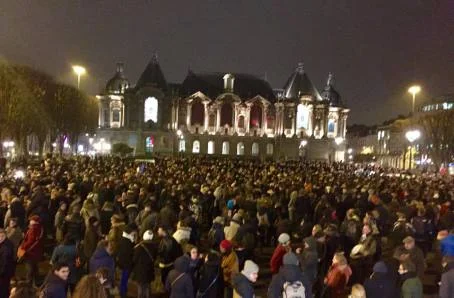
The whole nation had a day of mourning and every school in the country observed a minute of silence. This situation brought together a normally individualistic nation as one. The overwhelming solidarity impressed everyone.

In the main hall of my school, a large blank poster was hung where we could write a note, attach a picture, a poem, all to express our solidarity and feelings about this terrible act of violence.

"12 people dead, 66 million hurt" is one of the many sayings going around on social media. Although only a dozen people died, the whole population felt attacked. Not only because it was on their soil, but also because one of their rights had been violated. Freedom of speech had been brutally attacked. Everyone felt impacted.

Many different discussions arose in the following days. Some argued that the terrorist cruelly killed perfectly innocent people while others protested that the victims got what they deserved for being so rude and disrespectful toward all the Muslims. So although the French stood together in an act of outstanding solidarity after this devastating event, this has also created gaps, resentment and frustration among the Muslim population and the rest of France, and the Muslims and the extremists. The people who are not Muslim resent those who are because they feel that the crime was somehow their doing. Because of this the Muslims feel targeted because of what the terrorists did, and this leads to tension between these two groups of people in France.

This is something I've seen at my own school and around me. Several Muslims in my class have spoken in defense of the extremists, mentioning the way the magazine so greatly disrespected their religion in our “free” country. Others say that the freedom of speech gives them the right to mock, say and draw anything they like. But is this respecting other people's rights by breaking their religious laws? Even if you are not a member of their religion?  It was impossible to stay away from the typically taboo (in France) subject of religion during the ongoing conversations at my French public school.

Some Muslims refused to do the minute of silence and hence walked out of the room during the time designated for that purpose.

Compared to 9-11, this could be viewed as minor. The death toll was not enormous, the killers were caught within three days and life continued. But it has become a part of France's history, and it has changed people's viewpoint of the world in which they live in. No one lives in safety, and people are killed for what they think, even in a free country like France. 

Note: This family lives 30 minutes from where the attackers were finally killed--bringing this national tragedy even closer to home.

Insight from an Artist as His Nation Mourns

John Maust shared his Facebook message from artist Didier Millotte with OneWord Journal:

Didier also wrote me to say, "One of the artists who died was an illustrator I watched on TV when I was kid. Everyone knew him here. Tragedy in France, tragedy in Europe. Dark time. We need the Cross. We need Christ, the life of the Savior. We need to work to share the gospel. Your job at MAI is part of it. So precious."

2015 Insight

As a new year begins, we look back and ahead. What happened last year? We might look back and rejoice or we might look back at the year with regrets. With the first week of 2015 almost over, we can look forward to what might be possible in the year ahead.

So this month of January, we look for “insight.”

We could be looking at personal insights into life, relationships, God or something else. Whether it’s a memorable book read last year or something that happened recently in missions or a breakthrough in local ministry or witness, January 2015 is a time when we are open to looking back and ahead at the same time to discover new insights and new possibilities.

Let’s gain insight from one another.

In Proverbs 1:2, King Solomon wrote, “to know wisdom and instruction to understand words of insight.” Our goal, no, our prayer, is that these posts, these insights, will help us to understand—either for the first time or for the millionth timethat “the fear of the Lord is the beginning of knowledge; fools despise wisdom and instruction.” (Proverbs 1:7)

So here we go, into 2015, together.

Insight into Best Books We've Read

Missions Pastor Bruce Wilson's best books for 2014 included:

All the Light We Cannot See by Anthony Doerr. A beautifully written, poignant novel. (This book showed up on a few more lists this year.)

The Prize: The Epic Quest for Oil, Money & Power by David Yergin. Well-researched and engaging history of oil exploration and the impact of oil on our daily lives and world events.

Indonesia, Etc: Exploring the Improbable Nation by Elizabeth Pisani. Keen and occasionally humorous insight into the world's fourth most populous nation.

Director of Children's Ministries Diane Jordan chose these titles as some of her best books.

IF by Amy Carmichael. Actually a booklet that is only 27 pages, but so very inspiring, challenging and encouraging.  A call – almost like a diagnostic – to have us examine what we know of Calvary’s love by how we live our lives.

Is God Anti-Gay? by Sam Allberry. Sets forth what the Bible says about homosexuality, looks at cultural influences and gives great practical counsel.

Love Into the Light by Peter Hubbard. Again a book that sets forth a biblical understanding of the issues, and then challenges the church to look beyond the label to reach out and love the lost no matter who they might be.

God in the Whirlwind by David Wells was Pastoral Resident Ryan Potter's choice of his best book. Says Ryan about the book, "The book was a favorite because of the way Wells unpacks the gospel and its implications for our understanding of God. Often we emphasize either the holiness or love of God over and above the other, but in the cross we see that God's character is "Holy-Love," which both hates sin and loves us so much that he sent his son as a sacrifice for our transgressions. We are not left with a God that we conjure up from our own imaginations, but with God who is wholly other than ourselves and calls us to know him as he truly is."