A College Church MK Living in France Reflects on the Charlie Hebdo Tragedy

Shock was the first emotion that everyone felt, I believe. In the first moments of hearing the news, most could not believe what was really happening or how this could have happened.

In my high school this instantly became the main topic of conversation, debate and anxiety. The fear of further attacks, the tension between different opinions and viewpoints and the buzz of exciting news was everywhere you turned for the past several days. Mobile phones were being consulted regularly for any updates and the news was played everywhere. Lockdowns were happening to some of our friends' schools and everyone had things to say about the current situation.

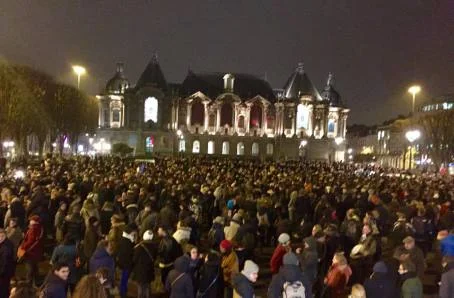
The whole nation had a day of mourning and every school in the country observed a minute of silence. This situation brought together a normally individualistic nation as one. The overwhelming solidarity impressed everyone.

In the main hall of my school, a large blank poster was hung where we could write a note, attach a picture, a poem, all to express our solidarity and feelings about this terrible act of violence.

"12 people dead, 66 million hurt" is one of the many sayings going around on social media. Although only a dozen people died, the whole population felt attacked. Not only because it was on their soil, but also because one of their rights had been violated. Freedom of speech had been brutally attacked. Everyone felt impacted.

Many different discussions arose in the following days. Some argued that the terrorist cruelly killed perfectly innocent people while others protested that the victims got what they deserved for being so rude and disrespectful toward all the Muslims. So although the French stood together in an act of outstanding solidarity after this devastating event, this has also created gaps, resentment and frustration among the Muslim population and the rest of France, and the Muslims and the extremists. The people who are not Muslim resent those who are because they feel that the crime was somehow their doing. Because of this the Muslims feel targeted because of what the terrorists did, and this leads to tension between these two groups of people in France.

This is something I've seen at my own school and around me. Several Muslims in my class have spoken in defense of the extremists, mentioning the way the magazine so greatly disrespected their religion in our “free” country. Others say that the freedom of speech gives them the right to mock, say and draw anything they like. But is this respecting other people's rights by breaking their religious laws? Even if you are not a member of their religion?  It was impossible to stay away from the typically taboo (in France) subject of religion during the ongoing conversations at my French public school.

Some Muslims refused to do the minute of silence and hence walked out of the room during the time designated for that purpose.

Compared to 9-11, this could be viewed as minor. The death toll was not enormous, the killers were caught within three days and life continued. But it has become a part of France's history, and it has changed people's viewpoint of the world in which they live in. No one lives in safety, and people are killed for what they think, even in a free country like France. 

Note: This family lives 30 minutes from where the attackers were finally killed--bringing this national tragedy even closer to home.
Insight from an Artist as His Nation Mourns

John Maust shared his Facebook message from artist Didier Millotte with OneWord Journal:

Didier also wrote me to say, "One of the artists who died was an illustrator I watched on TV when I was kid. Everyone knew him here. Tragedy in France, tragedy in Europe. Dark time. We need the Cross. We need Christ, the life of the Savior. We need to work to share the gospel. Your job at MAI is part of it. So precious."

2015 Insight

As a new year begins, we look back and ahead. What happened last year? We might look back and rejoice or we might look back at the year with regrets. With the first week of 2015 almost over, we can look forward to what might be possible in the year ahead.

So this month of January, we look for “insight.”

We could be looking at personal insights into life, relationships, God or something else. Whether it’s a memorable book read last year or something that happened recently in missions or a breakthrough in local ministry or witness, January 2015 is a time when we are open to looking back and ahead at the same time to discover new insights and new possibilities.

Let’s gain insight from one another.

In Proverbs 1:2, King Solomon wrote, “to know wisdom and instruction to understand words of insight.” Our goal, no, our prayer, is that these posts, these insights, will help us to understand—either for the first time or for the millionth timethat “the fear of the Lord is the beginning of knowledge; fools despise wisdom and instruction.” (Proverbs 1:7)

So here we go, into 2015, together.

Insight into Best Books We've Read

Missions Pastor Bruce Wilson's best books for 2014 included:

All the Light We Cannot See by Anthony Doerr. A beautifully written, poignant novel. (This book showed up on a few more lists this year.)

The Prize: The Epic Quest for Oil, Money & Power by David Yergin. Well-researched and engaging history of oil exploration and the impact of oil on our daily lives and world events.

Indonesia, Etc: Exploring the Improbable Nation by Elizabeth Pisani. Keen and occasionally humorous insight into the world's fourth most populous nation.

Director of Children's Ministries Diane Jordan chose these titles as some of her best books.

IF by Amy Carmichael. Actually a booklet that is only 27 pages, but so very inspiring, challenging and encouraging.  A call – almost like a diagnostic – to have us examine what we know of Calvary’s love by how we live our lives.

Is God Anti-Gay? by Sam Allberry. Sets forth what the Bible says about homosexuality, looks at cultural influences and gives great practical counsel.

Love Into the Light by Peter Hubbard. Again a book that sets forth a biblical understanding of the issues, and then challenges the church to look beyond the label to reach out and love the lost no matter who they might be.

God in the Whirlwind by David Wells was Pastoral Resident Ryan Potter's choice of his best book. Says Ryan about the book, "The book was a favorite because of the way Wells unpacks the gospel and its implications for our understanding of God. Often we emphasize either the holiness or love of God over and above the other, but in the cross we see that God's character is "Holy-Love," which both hates sin and loves us so much that he sent his son as a sacrifice for our transgressions. We are not left with a God that we conjure up from our own imaginations, but with God who is wholly other than ourselves and calls us to know him as he truly is."


Best Books of 2014, Part One

Pastor Josh Stinger had this to say about some of his best books of 2014

  • In Walking With God Through Pain and Suffering, Timothy Keller, as usual, provides a masterful blend of biblical scholarship, cultural apologetics, pastoral care and sensitivity on a difficult subject. Consider reading this before you go through something difficult.  It’s better to get your feet firmly planted on the rock before the storm hits. 
  •  1776 by David McCullough takes the reader through one of the most pivotal years in American and British history, primarily through the eyes of George Washington. The book is well paced and packed full of excellent historical narrative.
  • Having shared in the preaching duties through Romans at the south Wheaton campus, I found Romans (volumes 1-3) by D. Martin Lloyd-Jones to be theologically helpful and pastorally insightful. Originally preached by “the Doctor” over 50 years ago, it was fun and refreshing to read, particularly as commentaries go. I’ll be looking forward to reading the next few volumes this year in this 14 volume set.

The book that topped Pastor Steven Lee's list was Prayer: Experiencing Awe and Intimacy with God by Timothy Keller. Writes, Steven, "The best book I've read this year and the best book on prayer that I've come across. A Praying Life by Paul  Miller was also a great read on prayer (I've read it many times over the years) and I've read my fair share of E.M. Bounds, but Keller's book is particularly helpful because he shows the reader the reasons and motivations behind prayer, defines prayer against other writers that may have had a skewed understanding of prayer; then delves into practical ways to learn how to pray (citing extensively from Calvin, Augustine and Luther). It has enlivened by prayer life and I would highly recommend it.

Pastoral Resident Michael McKittrick describes some of his best books for 2014.

  • Everyday Church by Tim Chester and Steve Timmis. Church is more than an event on Sunday morning. The church is God's people together on mission for him. In this book, the authors use 1 Peter to help us think about how we can be the people of God every day. It is both a book that casts vision and practical ideas on how to be used by God all week long.
  • The Gospel at Work by Greg Gilbert and Sebastian Traeger. In my own life and as I talk to other, I have seen a struggle to know how one's work fits in with the calling to be a disciple of Jesus. This book helps answer that question. It is short, biblical and practical. If you want to learn more about how to honor God in your work or how your work has any value, then please read this book.
  • The Epic of Eden by Sandra Richter. While I do not agree with everything in this book, the author does a great job of helping Christians see how the Old Testament tells one big story that is fulfilled in Jesus Christ. It is useful in understanding both the background of the Old Testament and how the storyline fits together. This the book I would recommend as an entry point for those wanting to better understand the Old Testament.
  • Blink by Malcolm Gladwell. Malcolm Gladwell is a good writer. I'm not sure if he is a Christian, but I found this book fascinating as I read about how our minds work. Gladwell's book made me appreciate how intricately God has designed us and left me wanting to better follow Paul's instruction in Romans 12:1-2 to conform our minds to God rather than the patterns of this world. It also has some interesting thoughts that pertain to recent racial tensions and police actions that I found helpful.